

A scale model train isn't just a toy; it's a miniature, working replica of a real-world railway, built to a precise, consistent size. It’s a hobby that beautifully blends artistry with engineering and a touch of history, letting you build and operate your very own world in miniature.
Embarking on Your Model Railroading Journey
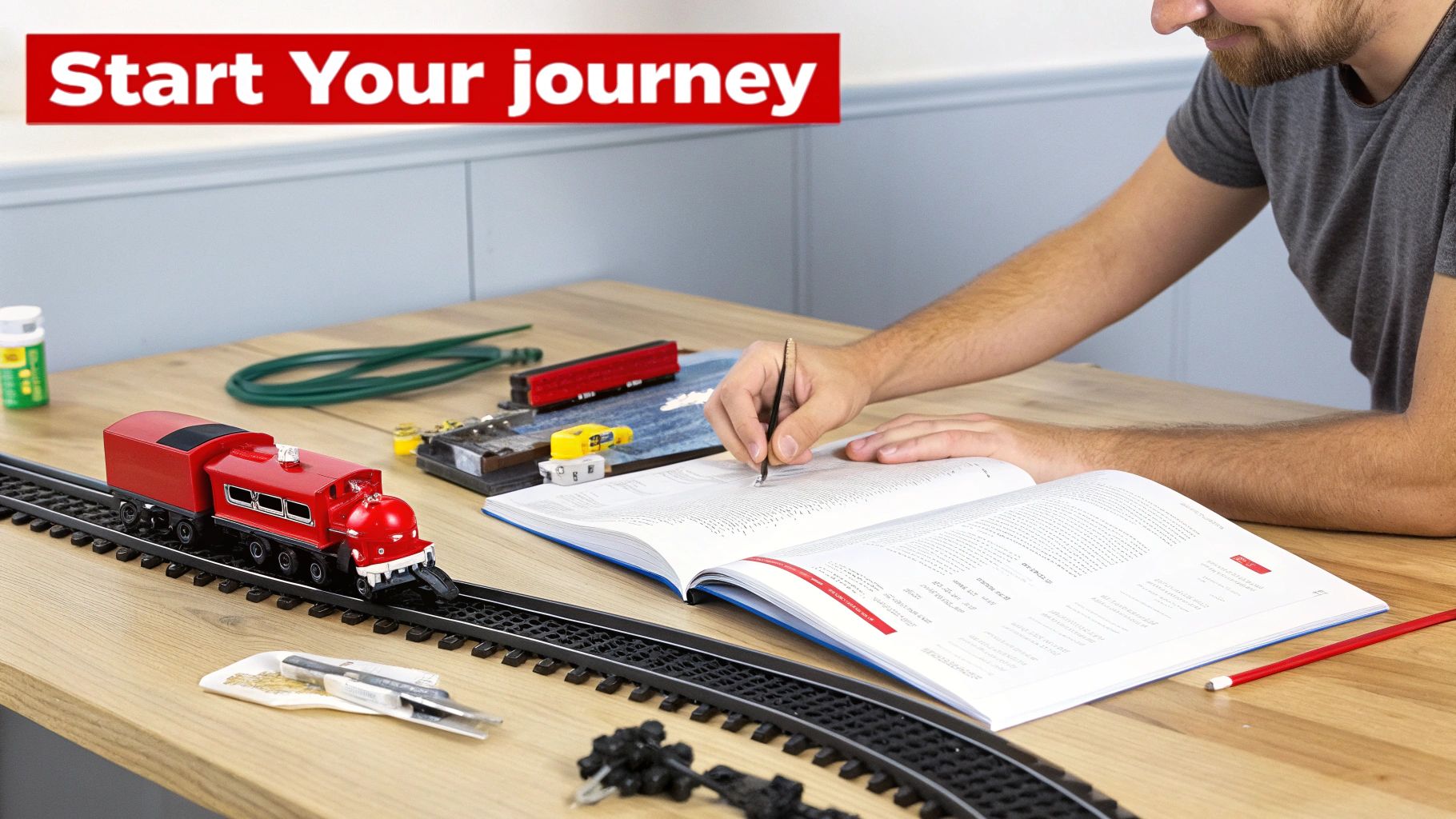
Welcome to the captivating world of model railroading. This hobby is so much more than just playing with trains—it’s about becoming a creator, an engineer, and even a storyteller. Each scale model train is a ticket to a world you build from the ground up, piece by piece. From the locomotive chugging down the main line to the tiny figures waiting at the station, every element comes together to form a living, breathing diorama.
Think of this guide as your roadmap into this incredibly rewarding pastime. We’re going to demystify the core concepts every new hobbyist needs to know, starting with the two most important terms in the hobby: scale and gauge. Getting a handle on these is the fundamental first step toward building a successful layout.
The Timeless Appeal of Model Trains
The allure of model railroading connects generations. It's a unique blend of different skills and passions, which means there’s something in it for everyone. Whether you're drawn to the precise mechanics of the locomotives, the artistic challenge of crafting realistic landscapes, or just the simple joy of watching a train run, you'll find your niche.
This hobby lets you:
- Unleash your creativity by designing track plans and building scenery.
- Develop technical skills through wiring, routine maintenance, and fun upgrades.
- Connect with history by modeling specific eras and iconic railway lines.
The enduring magic of model railroading lies in its ability to transport you. It’s a hands-on escape where you’re in control of every detail, creating a personal world that runs on your terms.
A Growing and Evolving Hobby
Far from being a forgotten pastime, model railroading is a dynamic and growing field. The global model train market was valued at approximately USD 1.18 billion and is projected to hit USD 2.22 billion by 2033, showing a huge resurgence in interest.
This growth is supercharged by modern technology like Digital Command Control (DCC), which brings a whole new level of realism and interactivity to your operations. You can read the full research about the model train market's growth for a deeper dive. Our goal is simple: to make this incredible hobby accessible, giving you the knowledge to build the railroad of your dreams with confidence.
Choosing the Right Model Train Scale
Picking a scale is one of the first, and most important, decisions you'll make on your model railroading journey. This single choice will shape everything that follows—from the tiny details you can add to a boxcar to the overall footprint of your layout. Think of it as choosing the right lens for a camera; it determines how you'll see and build your miniature world.
Your chosen scale dictates the size of every scale model train, building, and tree you'll ever add. We’ll walk through the most popular options out there, focusing on the "big three"—HO, N, and O—while also touching on the larger G and smaller Z scales. Each one has its own unique character, and finding the right fit is all about matching it to your vision.
HO Scale: The Popular All-Rounder
When most people imagine a model train, they're probably picturing HO scale. With a ratio of 1:87.1, it hits the sweet spot between detail and size. This makes it a fantastic starting point for newcomers and a long-time favorite for seasoned experts.
At this size, locomotives and cars are big enough to show off intricate details and are easy for both kids and adults to handle. Yet, they’re still compact enough to allow for interesting track plans in a reasonably sized room. A classic 4'x8' sheet of plywood is a common and excellent starting point for a great HO layout.
The biggest advantage of HO scale is its massive popularity. It’s the most widely used scale in the model train world, especially in North America and Europe. In fact, some forecasts suggest annual sales for HO scale trains could hit 180,000 units in North America alone. This widespread adoption means you'll have an incredible selection of trains, buildings, vehicles, and accessories from a huge range of manufacturers.
N Scale: Maximum Railroading in Minimum Space
If your dream layout involves long, winding freight trains and sweeping landscapes but you're short on space, N scale is your answer. With a ratio of 1:160, N scale models are about half the size of their HO counterparts. This is a game-changer: you can fit roughly four times the layout into the same physical area.
This smaller size is perfect for apartment dwellers or anyone who wants to model grand, panoramic scenes. Imagine mainline tracks snaking through mountain ranges or a sprawling urban freight yard—these are the kinds of layouts where N scale truly shines.
Of course, the smaller size comes with a couple of trade-offs. The models can be more delicate and a bit trickier to handle. Adding fine details or doing maintenance might require a steady hand and good lighting. Even so, the variety of N scale products has exploded in recent years, making it a very strong contender.
N scale's superpower is its ability to convey distance and scope. It allows you to create a sense of a journey, where a train can travel through diverse scenery for a significant time before returning to its starting point.
O Scale: The Heavyweight Champion
For those who crave impressive size, weight, and sheer presence, O scale delivers an unforgettable experience. Usually associated with a 1:48 ratio in the United States, O scale trains are big, beefy, and have a commanding look and feel. The larger models allow for an incredible level of detail, from readable lettering on the side of a boxcar to individually applied grab irons on a locomotive.
The main consideration for O scale is, without a doubt, space. The trains are large, and the track curves need a generous radius. This makes the scale best suited for those with a dedicated basement, garage, or a large spare room to work with. The cost per item is also generally higher compared to the smaller scales.
- Detail: Unmatched level of fine detail is possible.
- Presence: The size and weight give trains a realistic heft.
- Sound: Larger models provide plenty of room for high-quality speakers, resulting in incredible, room-filling sound effects.
To help you visualize these options side-by-side, we've put together a quick comparison table. This should make it easier to see how each scale stacks up based on what matters most to you.
Comparing Popular Model Train Scales
A side-by-side comparison of the key characteristics of popular model train scales to help you choose the best fit for your space, budget, and interests.
| Scale | Ratio | Primary Advantage | Primary Disadvantage | Best For |
|---|---|---|---|---|
| O Scale | 1:48 | Incredible detail and presence | Requires significant space and budget | Collectors, high-detail modelers, large rooms |
| HO Scale | 1:87.1 | Excellent balance of size and detail; huge variety | Needs a decent amount of space for a complex layout | Beginners and experts alike; the all-around choice |
| N Scale | 1:160 | Fits a large layout in a small space | Models can be small and tricky to handle | Apartment dwellers, modeling long trains and vast landscapes |
Ultimately, choosing the perfect scale model train comes down to balancing your creative dreams with the practical realities of your space and budget. If you're interested in a more detailed breakdown, be sure to check out our complete guide which explains the key differences between model railway scales and can help you visualize each option.
Planning Your Layout Space and Budget
Once you have a scale in mind, it's time to get down to brass tacks. We're talking about the two most practical parts of our hobby: the space you have available and the budget you're working with. These two factors are the true architects of your future railway, guiding your choices and helping you build a scale model train layout you'll enjoy for years to come. A great layout isn't about having the most room or the deepest pockets; it's about smart planning from day one.
Before you even think about buying a single piece of track, grab a tape measure. Seriously. Understanding the real-world dimensions you have to work with is the most critical first step. Are we talking about a spare bedroom, a corner of the basement, a garage, or just a small shelf in an apartment? Each one of those spaces holds unique potential.
For example, the classic 4'x8' sheet of plywood has been the traditional starting block for HO scale for decades, giving you enough room for a continuous loop with some decent scenery. But don't feel locked into that old standard. Modern layout design is all about finding creative shapes that are more accessible and visually interesting.
Designing for Your Space
The area you have will shape the kind of railroad you can build. Think beyond just a simple oval on a flat table. To really make the most of your space and maximize the fun, consider these popular design approaches:
- Continuous Loop: This is the classic design where a train can run in a circle without any help. It’s fantastic for just sitting back and watching your trains roll by, making it a perfect starting point for beginners.
- Point-to-Point: This style mimics a real railroad by having a distinct starting and ending point. It’s perfect for modeling realistic operations, like picking up freight cars in one town and dropping them off in another.
- Shelf Layout: Got a small space? A shelf layout is your best friend. These narrow layouts run along one or more walls, forcing you to focus on creating incredibly detailed, eye-level scenery. They are brilliant for point-to-point operations.
This visual guide can help connect the dots between your available space and a good starting scale.
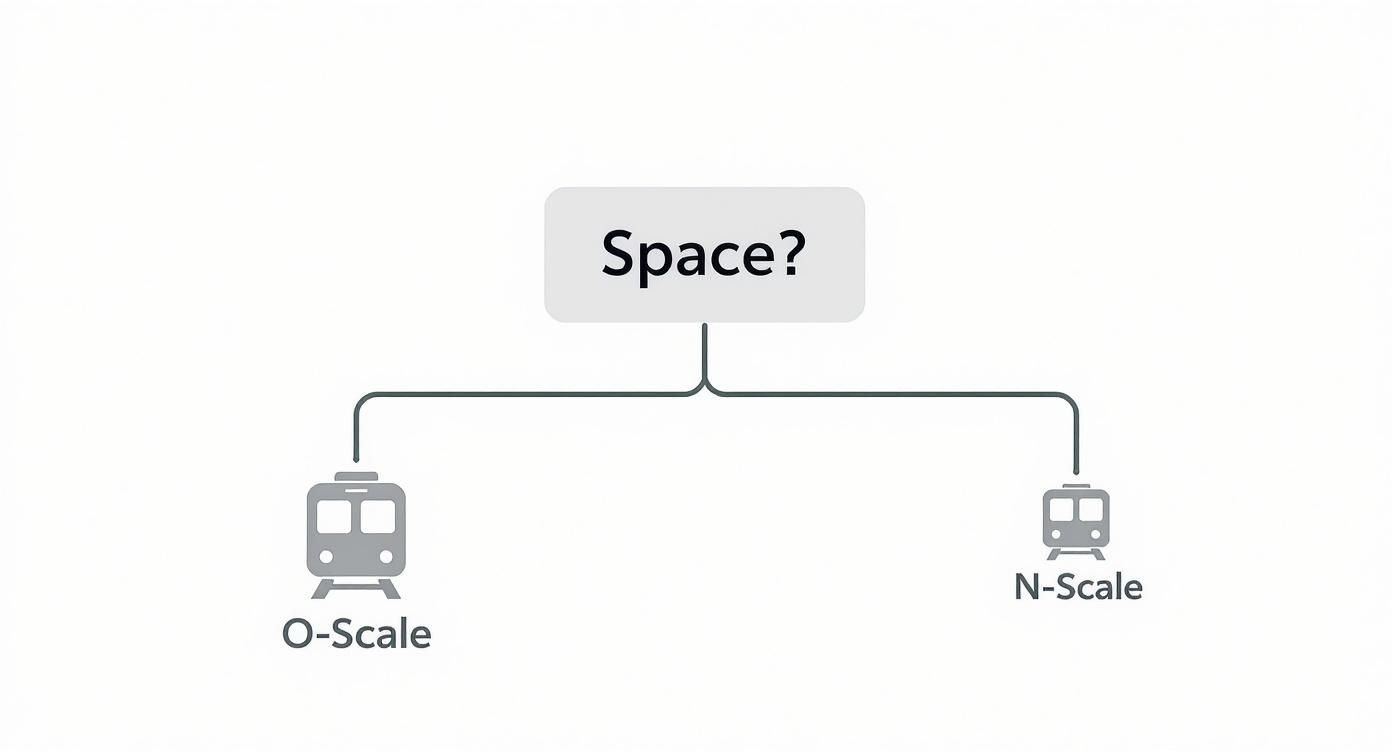
As you can see, a large room opens up possibilities for bigger scales like O, while smaller spaces are a perfect match for the compact footprint of N scale.
Building Your Railway on a Budget
You can get into model railroading at almost any price point. The secret is to spend your money wisely and let your collection grow over time. There's a common myth that you need to drop thousands of dollars just to get started, but that's simply not the case.
The best layouts are not necessarily the most expensive ones. They are the ones that reflect careful planning, creativity, and a clear vision, regardless of the budget.
Here’s a rough idea of where your initial money will likely go:
- Starter Sets: Often the most budget-friendly way in. A good set will give you a locomotive, a few cars, a basic loop of track, and a power pack. It’s an all-in-one box that gets your first train running in minutes.
- Locomotives and Rolling Stock: This is where your personal taste comes in. You can begin with one or two of your favorite locomotives and a small fleet of freight or passenger cars to pull behind them.
- Track and Controls: To build anything more interesting than a small oval, you’ll need more track. You'll also need a controller, which will either be a traditional DC power pack or a more advanced DCC system.
- Scenery and Structures: This is everything that brings your world to life—the ground cover, trees, buildings, bridges, and tiny details that tell a story.
To make your budget go further, start small and expand as you go. You don't have to build your dream layout on day one. Focus on getting a small section fully operational and detailed first. This approach not only keeps you motivated but makes the whole project feel much less overwhelming.
Understanding Your Train Control System
Beyond the track, scale, and scenery, the control system is the real heart of your scale model train operation. It's the technology that brings your locomotives to life, and the system you choose will define your entire modeling experience. You’ll face a fundamental choice between two very different approaches: classic Direct Current (DC) and modern Digital Command Control (DCC).
Think of DC control like a simple light dimmer switch for an entire room. When you turn the knob, every light on that circuit gets brighter or dimmer together. In the world of model railroading, this means you're controlling the speed and direction of the track itself. Any locomotive sitting on that track will respond in unison. It's a straightforward, reliable system that has been the standard for generations.
The Simplicity of Direct Current (DC)
DC is the traditional way to run model trains, and it's perfect for beginners or anyone who loves a simple, direct approach. The setup couldn't be easier: just two wires run from your power pack to the track. Turning a knob sends variable voltage through the rails, making the train go faster or slower. Flicking a switch reverses the polarity, and the train changes direction.
That simplicity is its greatest strength. It’s affordable, easy to troubleshoot, and ideal for running a single train on a basic loop of track. The main limitation shows up when you want to run more than one train independently. To do that with DC, you have to build complex electrical blocks with separate wiring and switches for each section—a project that can get complicated fast.
Embracing Digital Command Control (DCC)
Digital Command Control, or DCC, is the modern evolution of train operation. Think of it less like a room dimmer and more like a smart home system. With DCC, you can control every single light bulb—or in our case, every locomotive—independently, even if they're all on the same circuit.
DCC sends a constant stream of digital information through the rails at all times. Each locomotive is fitted with a tiny onboard computer called a decoder. This decoder has a unique address, and it listens for commands sent specifically to it. This unlocks a whole new world of possibilities, allowing you to:
- Run multiple trains on the same track, at different speeds, in different directions.
- Control each locomotive independently.
- Turn on headlights, bell sounds, and horn effects with the push of a button.
This level of control opens up realistic operations that are simply impossible with a basic DC system. DCC is a huge driver of the hobby's ongoing appeal. In fact, market analysis suggests the broader model train market will grow to approximately USD 6.69 billion by 2031, partly due to these advanced control systems. You can discover more insights about the model train market's future on reportprime.com.
DCC transforms your role from a simple operator into a true railroad engineer. You're no longer just controlling the track; you're communicating directly with each locomotive, managing a fleet of engines with precision and realism.
Choosing Between DC and DCC
So, which system is right for you? There's no single correct answer—it all comes down to your goals, budget, and how you envision your layout operating.
| Control System | Primary Advantage | Primary Disadvantage | Best For |
|---|---|---|---|
| DC (Direct Current) | Simple, affordable, and easy to set up. | Running multiple trains requires complex wiring. | Beginners, small layouts, or hobbyists on a tight budget. |
| DCC (Digital Command Control) | Allows independent control of multiple trains. | Higher initial cost and requires decoder installation. | Modelers seeking realistic operation and advanced features. |
If you're just starting out with a simple loop and want to enjoy watching a train run, DC is a fantastic and cost-effective way to get going. But if your long-term vision includes multiple trains, sound effects, and realistic yard operations, investing in a DCC system from the beginning is often the wiser choice. To better understand the options available, you can check out our detailed guide on the different types of train control systems.
Bringing Your World to Life with Scenery
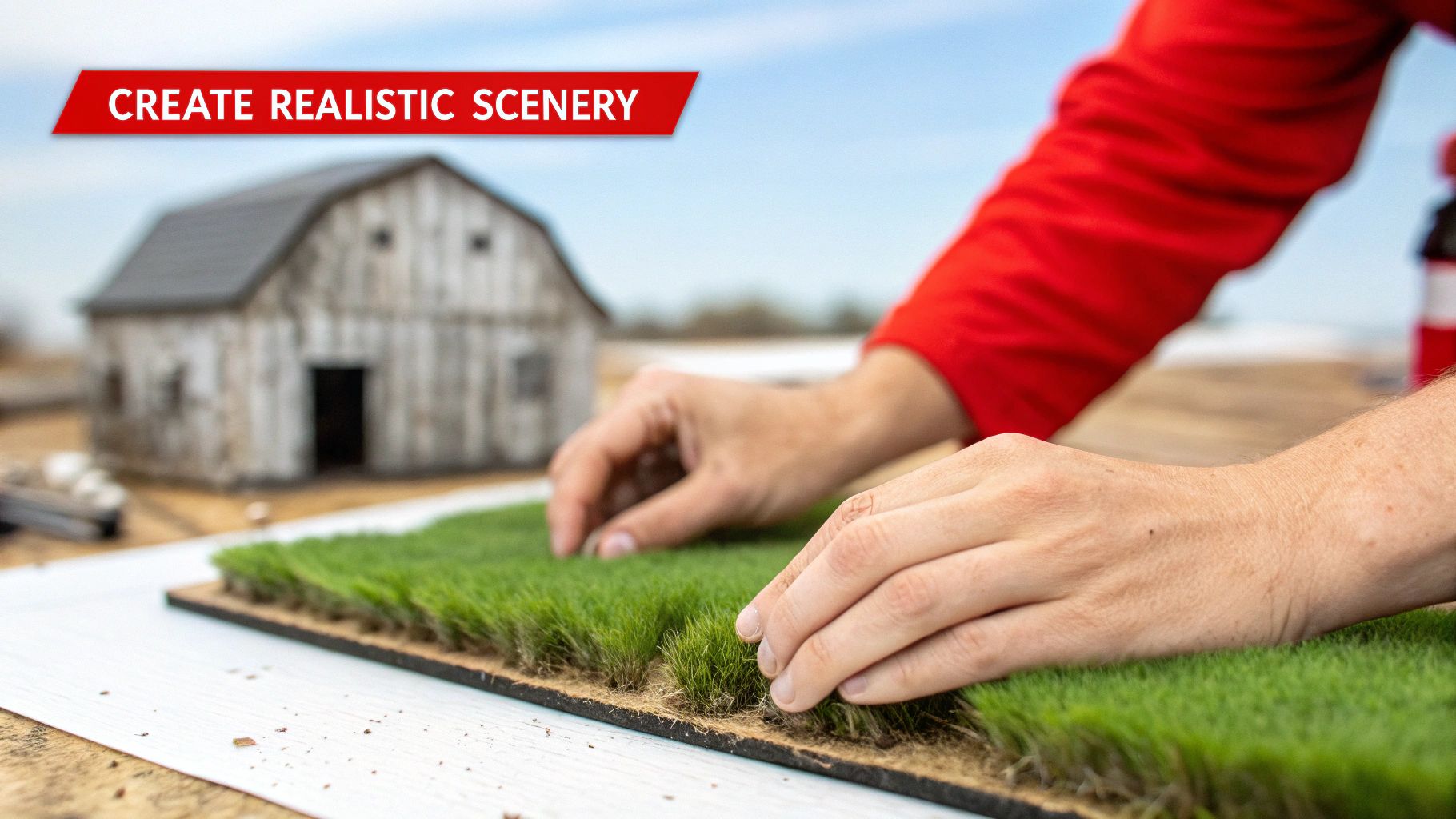
This is where the real magic happens. Scenery is what transforms your collection of track and trains into a living, breathing miniature world. It’s the artistic soul of the hobby, the part where you get to tell a story, set a mood, and build a believable environment for your scale model train to call home.
A layout with great scenery is more than just a place for trains to run—it’s a destination.
Building out your world is one of the most rewarding parts of model railroading. You get to play geologist, civil engineer, and landscape artist all at once. From carving dramatic mountain ranges out of foam to planting serene forests tree by tree, every step adds another layer of personality to your layout.
Building Your Landscape from the Ground Up
The foundation of any great scene starts with the landforms themselves. These are the hills, valleys, and mountains that give your layout its unique topography and visual punch. One of the most popular and versatile materials for this job is rigid foam insulation board. It's lightweight, dead simple to shape, and can be stacked to create some seriously impressive elevations.
Once your basic landforms are in place, it’s time to add texture and color. This is where your world really starts to feel real.
- Ground Cover: Think of this as your base layer. Materials like ground foam, fine dirt, and ballast (the tiny stones under the track) are applied to create the first layer of realism.
- Static Grass: For creating realistic fields and overgrown patches, nothing beats a static grass applicator. This cool tool uses an electric charge to make tiny fibers stand straight up, perfectly mimicking blades of grass.
- Trees and Foliage: From towering pines to leafy deciduous trees, adding vegetation is crucial. You can buy pre-made trees for a quick result or build your own for a more custom, signature look.
- Water Features: Rivers, lakes, and ponds add a dynamic and reflective element. This is usually done with special two-part epoxy resins that cure into a hard, clear, and incredibly realistic water surface.
Scenery is what gives a layout its sense of place and time. A dusty, sun-baked desert landscape tells a very different story than a lush, green forest, and both are created with the same foundational techniques.
Adding Structures and Personality
With your landscape taking shape, the next step is adding the man-made elements that give your railroad a reason to exist. Buildings are key storytelling tools. A busy passenger station creates a hub of activity, while a forgotten, weathered barn out in a field hints at a quiet, rural history.
You generally have three options when it comes to adding structures:
- Ready-Made Buildings: These are pre-built and painted, ready to be placed right on your layout. They’re fantastic for getting a scene finished quickly.
- Assembly Kits: This is the most common route. Kits provide plastic or wood parts that you assemble and paint yourself, giving you much more control over the final look.
- Scratch-Building: For the ultimate in customization, scratch-building involves creating a structure from raw materials like styrene sheets, wood strips, and your own plans. It's an advanced technique that offers unmatched creative freedom.
The structures you choose will define the character of your railroad. Many modelers even study real-world photos to ensure their buildings—and where they place them—feel completely authentic.
Telling a Story with Your Scenery
Every single element you add contributes to the overall narrative. The placement of a single road crossing, a small cluster of figures waiting for a train, or a hand-painted billboard can instantly tell viewers what era you're modeling and what’s happening in your world.
A detailed guide to the essential diorama supplies you'll need can help you find the right materials to bring your vision to life. To really push the immersion, consider integrating realistic machine sound effects for your locomotives, factories, or sawmills. This auditory layer makes a static scene feel incredibly dynamic, adding another dimension of realism to your scale model train world.
Maintaining and Upgrading Your Collection
A model railroad is never truly “finished”—and that’s a good thing. It's a living, breathing project that evolves right along with you. But just like any piece of precision machinery, your trains need a little TLC to keep them performing at their best. Let's talk about the essentials of keeping your collection running flawlessly and the exciting world of performance upgrades.
Proper maintenance is the secret ingredient to a reliable, long-lasting layout. It's what stops frustrating hiccups in their tracks and protects the investment you've made in your hobby. Think of it as a quick tune-up that guarantees every operating session is a joy. Without it, even the most beautiful, high-end locomotive can sputter to a halt because of something as simple as dirty wheels.
Essential Maintenance Checklist
The best way to keep your railway in peak condition is to get into a simple routine. Focusing on these key areas regularly will prevent problems long before they start.
- Track Cleaning: Your tracks are the lifeline for the whole operation, carrying electricity from the power pack to your locomotives. Over time, they collect dust, oil, and a thin layer of oxidation that can interrupt that electrical connection. A dedicated track cleaning block or a soft, lint-free cloth with a bit of isopropyl alcohol is all you need to wipe the tops of the rails until they shine.
- Wheel Cleaning: Just like your track, the wheels on your locomotives and rolling stock pick up the same grime. It's crucial to clean them every so often with a cotton swab and alcohol. This simple step ensures your engines have a solid electrical pickup and run without stalling.
- Locomotive Lubrication: Inside your engine, the gears and moving parts need tiny amounts of specialized lubricant to run smoothly and quietly. Always check the manufacturer's instructions, but a good rule of thumb is to apply a very small drop of hobby-grade oil to the gears and axles every 20-30 hours of runtime. Remember, less is always more—too much oil just attracts dirt and gunk.
Upgrading Your Fleet for Realism
Once you've mastered the basics of maintenance, the really exciting stuff begins: upgrades. This is where you can take a good-running model and turn it into something truly exceptional, adding new layers of performance and realism. Upgrades are a fantastic way to keep the hobby fresh and engaging as your skills develop.
An upgrade is more than just a technical improvement; it’s an opportunity to personalize your collection. Transforming a silent locomotive into one that roars to life with authentic sounds is one of the most satisfying moments in the hobby.
Ready to take your collection to the next level? Consider these popular enhancements:
- DCC Conversion: Many older DC (Direct Current) locomotives can be converted to run on a modern DCC (Digital Command Control) system. This involves installing a small decoder inside the locomotive's shell, which lets you control it independently and unlock cool features like custom lighting.
- Sound Installation: For many modelers, this is the ultimate upgrade. Installing a sound decoder and a tiny speaker brings your locomotive to life with engine rumbles, horn blasts, and bell rings that all respond to your commands. It completely changes the feel of your layout.
- Coupler Swaps: Most starter sets come with basic "horn-hook" couplers. Swapping these out for more realistic and reliable knuckle couplers (like those from Kadee) is an easy, low-cost upgrade that dramatically improves how well your trains run together.
At Fusion Scale Hobbies, we support every step of your journey, offering everything from track cleaning supplies to high-performance SoundTraxx and ESU decoders to make your next upgrade a success.
Common Questions About Scale Model Trains
Diving into any new hobby means you’re going to have questions, and the world of model railroading is no different. We’ve rounded up some of the most common things newcomers ask to give you quick, clear answers. This should help you get past that initial learning curve and start building with confidence.
From figuring out what actually comes in a starter set to making sure different brands play nicely together, these are the insights that will demystify the basics. Think of it as your go-to FAQ for a smoother start on your model railroading journey.
What Is the Best Scale for a Beginner?
For most people just getting their feet wet, HO scale is the ideal choice. It really hits that sweet spot, balancing great detail with manageable space requirements. The models are large enough that you can handle them easily, which is great for both younger hobbyists and adults.
But the biggest advantage is its popularity. HO is the most common scale worldwide, period. That means you’ll have access to the widest possible variety of locomotives, freight cars, buildings, and accessories from countless manufacturers. This massive selection makes it easy to find exactly what you want to build the railroad you've been dreaming of, without running into dead ends.
Can I Mix and Match Different Brands?
Yes, for the most part, you absolutely can! As long as you stick within the same scale, components like locomotives, freight cars, and track are designed to be compatible across different brands. An HO scale locomotive from one company will run perfectly on HO scale track from another.
The one area you’ll want to keep an eye on is the couplers—the little mechanisms that hook your cars together. While most brands have standardized on a compatible knuckle-style coupler, some older models or budget starter sets might use a different type. The good news is they're usually simple to swap out for a standard type, ensuring everything in your collection can connect.
The ability to mix and match within a single scale is a cornerstone of the hobby. It gives you the freedom to pick and choose the best products from every brand to create a truly unique and personalized collection.
Do I Need to Be an Expert in Electronics?
Not at all. Getting your first train running is surprisingly simple. A basic Direct Current (DC) layout just needs two wires connected from the power pack to the track. That's it. Modern Digital Command Control (DCC) starter sets are often even easier, designed to be plug-and-play right out of the box.
While you can definitely dive into more advanced wiring for things like signals, automatic switches, and lighting down the road, you don't need any prior electronics knowledge to enjoy the core of the hobby.
Many enthusiasts also enjoy sharing their progress online. If that sounds like fun, you can find a helpful guide on making videos about your model train setups to share your passion with a wider audience.
No matter what questions you have, Fusion Scale Hobbies has the answers and the supplies you need. From your very first starter set to advanced DCC systems and scenery materials, explore our huge selection to bring your model railroad to life. Find everything you need at https://fusionscalehobbies.com.