

So, what exactly is a 1:48 scale model? At its heart, the concept is simple: it’s a detailed replica that’s exactly 1/48th the size of the real-world object it represents.
To put that into perspective, for every 48 inches (or four feet) on the actual subject, the model will be just one inch long. This simple ratio creates a fantastic middle-ground that modelers have come to love for its perfect balance of detail and presence.
Welcome to the World of 1:48 Scale Models
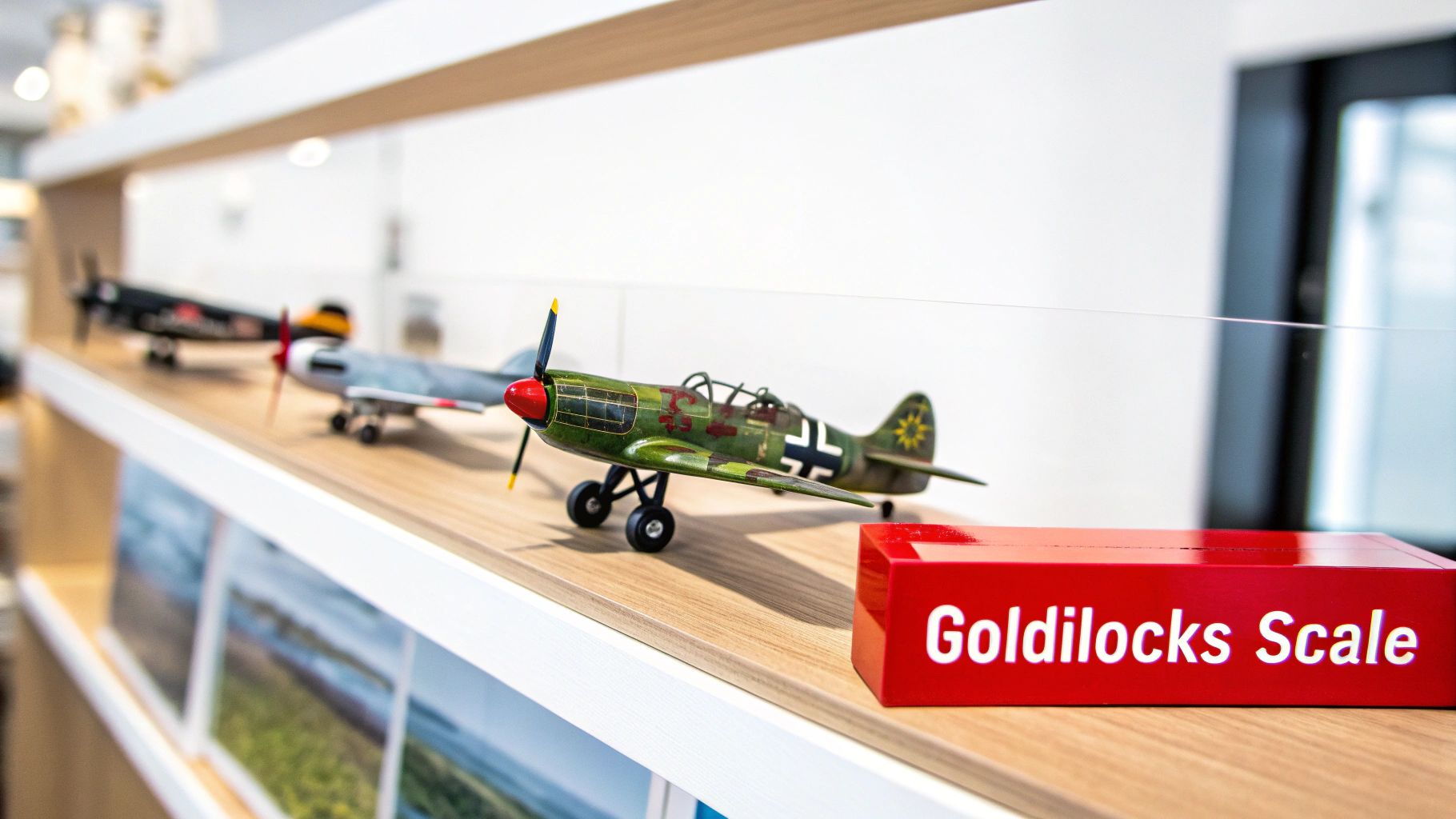
Often called the "Goldilocks" scale in the modeling world, 1:48 is not too big, not too small—it’s just right. This sweet spot makes it a favorite for everyone from first-time builders to seasoned experts. The models are large enough to pack in tons of incredible detail, like cockpit instruments and intricate panel lines, yet they remain a manageable size for both your workbench and your display shelf.
This incredible balance is a big reason the scale is a powerhouse in the hobby. The global market for plastic model kits was valued at around USD 5.2 billion in 2023 and is only expected to grow. Aircraft kits, which are dominated by the 1:48 scale, make up a huge chunk of that, accounting for an estimated 35-40% of all sales. For a deeper dive, you can check out more on the plastic model kits market trends on dataintelo.com.
The Perfect Balance of Detail and Size
What really makes the 1:48 scale shine is that perfect equilibrium it strikes. Unlike smaller scales where details can become almost microscopic and tough to work with, this scale gives you a substantial canvas.
It’s a scale that invites you to try more advanced techniques. Weathering effects look more realistic, fine photo-etched metal parts are easier to handle, and there’s enough room to scratch-build your own custom components.
Let's take a quick look at what makes this scale so appealing.
Understanding 1:48 Scale At a Glance
| Attribute | Description |
|---|---|
| Size | Large enough for high detail, small enough for easy display. |
| Detail Potential | Ideal for adding aftermarket parts, weathering, and scratch-building. |
| Subject Variety | Extensive selection across aircraft, military vehicles, and O scale trains. |
| Accessibility | Great for both beginners and advanced modelers. |
This table shows why 1:48 is often the first choice for hobbyists who want impressive, detailed models without needing a massive amount of space.
This combination of features has led to an amazing variety of subjects for builders. The world of 1:48 scale models is incredibly diverse, with something for pretty much any interest:
- Aircraft: Home to iconic WWII fighters like the P-51 Mustang and modern supersonic jets. It's the king of aircraft scales.
- Military Vehicles: A growing and popular range of tanks, armored personnel carriers, and support vehicles.
- O Scale Trains: This scale is the standard for American O Scale model railroading, allowing for seamless integration between your trains and dioramas.
- Die-cast Vehicles: You'll find tons of highly detailed replicas of classic cars and heavy construction equipment.
In essence, 1:48 scale gives you the perfect platform for creating models that are visually stunning from a distance and packed with rich detail when you look closer. It's an invitation to build a miniature world that feels real and authentic.
Whether you're drawn to the roar of a jet engine, the rumble of a tank, or the clickety-clack of the railways, this scale offers a rewarding and accessible way into the hobby. It sets the stage for a journey filled with creativity, history, and the pure satisfaction of building something with your own two hands.
The Lasting Appeal of Quarter Scale
To really get why 1:48 scale models are still so popular today, you have to rewind the clock a bit. This scale wasn't just picked out of a hat; it grew from a super practical and intuitive way of measuring things that just clicked with model builders, especially in the boom years after World War II.
That era was the dawn of the plastic modeling hobby, and manufacturers needed a standard size that was easy for regular folks to understand. The solution they landed on was brilliant in its simplicity, earning 1:48 its famous nickname: "Quarter Scale."
The Birth of Quarter Scale
So, where did the name "Quarter Scale" come from? It's a direct nod to the imperial measurement system. In this scale, one-quarter of an inch on the model equals one foot on the real thing. That simple conversion made it incredibly easy for modelers to visualize and work with.
Unlike metric-based scales that often required a calculator, anyone with a standard American ruler could quickly measure a part and know exactly how big it was supposed to be in the real world. This user-friendly approach was a huge reason it caught on so fast.
For the hobby's early pioneers, this wasn't just a minor convenience—it was a game-changer. It tore down a major barrier, making the hobby more welcoming and fun for a whole generation of builders eager to recreate the iconic machines they saw in the newsreels.
Smart manufacturers saw the potential and started pumping out kits, especially aircraft, in this new, logical scale. They realized it hit the sweet spot, offering a perfect compromise between the tiny, less-detailed models in smaller scales and the huge, often pricey kits in the larger ones.
How It Became the Gold Standard for Aircraft
As the hobby grew up, 1:48 scale cemented its place as the undisputed king for aircraft models. The size was just right for packing in all the cool details—like cockpit interiors, complex landing gear, and engine parts—without being so big that it would take over your entire display shelf.
Big-name kit makers of the day, like Monogram and Aurora here in the States, really went all-in on the scale. They released a flood of kits covering everything from famous warbirds to the first jets. This created a powerful snowball effect. The more kits they made, the more modelers bought them, which then pushed the companies to produce an even wider range of planes and aftermarket goodies.
This cycle built a massive, rock-solid ecosystem for 1:48 scale models that's still going strong. Today's builders get to stand on the shoulders of giants, with access to an incredible catalog of kits, decals, photo-etched detail sets, and resin upgrades. It's a legacy built on practicality and a shared obsession with getting the details just right.
- Simple Math: The quarter-inch-to-one-foot ratio made measuring and scratch-building a breeze.
- Post-War Boom: The scale took off as plastic model kits became a massive hobby after WWII.
- Industry Backing: Major companies standardized their aircraft lines in 1:48, creating a huge market.
- Perfect for Detail: The size was big enough for intricate work but small enough to manage.
This history is why the scale is still such a big deal. As you get deeper into the hobby, you might even find that some of your builds gain value over the years; certain scale models can become surprisingly sought-after, a bit like other vintage items worth significant money that appreciate over time. The enduring legacy of Quarter Scale proves it's not just a size—it's a cornerstone of the modeling world.
Exploring the Most Popular 1:48 Scale Subjects
The real beauty of 1:48 scale is just how much ground it covers. This isn't some tiny, specialized corner of the hobby—it's a massive universe packed with subjects for just about every interest you can imagine. Whether your passion is for aviation, armor, or railways, 1:48 gives you an incredible canvas to tell stories in miniature.
And it's a huge player in the hobby world. The global market for plastic model kits hit around USD 2.82 billion in 2024 and is expected to climb to USD 4.95 billion by 2033. Kits in 1:48 are a big piece of that pie, making up roughly 15-20% of all aircraft and military model sales. You can find more details in the plastic model kits market report on marketreportsworld.com.
What that popularity means for you is a staggering selection of kits. Let's take a tour of the heavy hitters and see what makes each one so special.
Aircraft: The Undisputed King of 1:48
When you hear 1:48 scale models, your mind probably jumps straight to aircraft. For good reason. This scale is the undisputed home turf for aviation modeling, striking that perfect balance between impressive size and intricate detail that really brings legendary flying machines to life.
A finished 1:48 fighter jet has some serious presence. A P-51 Mustang, for instance, boasts a wingspan over nine inches, making it large enough to let you appreciate every rivet, panel line, and cockpit dial. At the same time, it’s not going to hog your entire display shelf like a massive 1:32 scale kit would.
This sweet spot makes it the go-to for modelers and manufacturers alike. You’ll find an absolutely mind-boggling range of subjects out there:
- World War II Warbirds: From the graceful Spitfire to the beastly F4U Corsair, every iconic fighter, bomber, and recon plane is incredibly well-represented.
- Early Aviation: Those delicate, fabric-winged biplanes from World War I are available in stunning detail, offering a fantastic building challenge.
- Modern Military Jets: Sleek powerhouses like the F-16 Falcon and F/A-18 Hornet are wildly popular, often featuring complex weapons loadouts and jam-packed cockpits.
- Civilian and Experimental Aircraft: They’re a bit less common, but you can definitely track down kits for civilian planes and unique, one-off prototypes.
The sheer volume of aftermarket parts—resin cockpits, photo-etched details, and endless decal options—makes the aircraft category in 1:48 a world of its own. It gives you the power to create a hyper-realistic replica of a specific historical aircraft, right down to the last detail.
Military Vehicles: A Growing Powerhouse
While 1:35 has long been the king of the hill for military armor, 1:48 scale models have carved out a serious and fast-growing niche. This scale presents a compelling alternative, especially if you're interested in building dioramas that mix ground vehicles with aircraft.
The biggest win here is consistency. A 1:48 scale Sherman tank looks perfectly at home parked next to a 1:48 scale P-47 Thunderbolt, which lets you create scenes that are realistic and visually cohesive. The models are big enough for impressive detail but still compact enough to fit more action into a diorama without making it feel cluttered.
Manufacturers have jumped on this trend, releasing a fantastic lineup of armor and soft-skin vehicles. The selection is always growing, giving builders more and more toys for their historical sandboxes. It's an exciting space for anyone wanting to build dynamic, multi-faceted dioramas. If you're looking to dive into armor, be sure to check out our guide to the best tank models for hobbyists.
O Scale: The Model Railroading Connection
One of the coolest things about 1:48 scale is its direct tie-in with the world of model railroading. Here in the United States, 1:48 is the standard for O Scale trains. This perfect alignment unlocks a universe of creative possibilities for anyone building a layout.
It means that every single 1:48 scale military truck, civilian car, or figure you find is already perfectly proportioned to sit alongside O Scale locomotives, rolling stock, and structures. This synergy makes creating incredibly detailed and believable train layouts so much easier.
Just picture a bustling 1940s railyard scene:
- An O Scale steam locomotive chugging along with a line of freight cars.
- A 1:48 scale military Jeep and a deuce-and-a-half truck waiting at a crossing.
- Figures in 1:48 scale scattered about, representing railroad workers and soldiers.
This built-in compatibility lets you populate a train layout with authentic details that make the entire scene pop. Whether you're an armor modeler thinking of dabbling in trains or a railroader wanting to inject more realism, this connection is one of the scale's greatest strengths.
Visualizing Size and Planning Your Workspace
It’s one thing to know what the numbers on the box mean, but it’s another thing entirely to really feel the physical size of 1 48 scale models. Before you fall in love with that massive bomber kit or start sketching out a sprawling O Scale empire, it pays to translate those ratios into real-world inches.
This little bit of homework can save you from the classic modeler’s headache: finishing a masterpiece only to realize it won’t fit on the shelf you built it for. A few minutes of planning now ensures your collection has plenty of room to grow and shine.
Converting Real-World Size to Model Dimensions
Figuring out a model's final dimensions is surprisingly simple. Since 1:48 scale just means the model is 1/48th the size of the real deal, you just need to find the full-size object's dimensions, convert them to inches, and divide by 48.
The formula looks like this:
(Real-world length or wingspan in feet) x 12 / 48 = Model dimension in inches
But we can make that even easier. Since 12 divided by 48 simplifies to 1/4, the math becomes a breeze: just divide the real-world dimension in feet by 4. This is exactly where the "Quarter Scale" nickname comes from!
Practical Example: Sizing a P-51 Mustang
A real North American P-51D Mustang has a wingspan of about 37 feet.
Using our quick formula: 37 feet / 4 = 9.25 inches.
Your 1:48 scale P-51 model will have a wingspan right around 9.25 inches—a perfect, manageable size for most display cases.
This simple trick is your best friend when you're browsing for a new project. Just look up the dimensions of the actual aircraft or vehicle online, do that quick division, and you'll know exactly how much bench and shelf space you're committing to.
Comparing 1 48 Scale Models to Other Popular Scales
So, how does 1:48 scale stack up against other common choices? Let's take that same P-51 Mustang and see how big it would be in the other two most popular aircraft scales. The difference is more dramatic than you might think.
Here's a quick look at how the same aircraft compares across different scales, giving you a real sense of their physical presence.
Scale Size Comparison of a P-51 Mustang
| Scale | Approx. Length | Approx. Wingspan | Key Characteristic |
|---|---|---|---|
| 1:72 | 5.4 inches | 6.2 inches | Very compact; great for collecting many aircraft in a small space, but details are tiny. |
| 1:48 | 8.1 inches | 9.3 inches | The "just right" balance of impressive detail and manageable display size. |
| 1:32 | 12.1 inches | 13.9 inches | A massive and highly detailed model that demands significant display and work space. |
As you can see, the jump between scales isn't minor. A 1:32 scale model is a serious commitment of space, while a 1:72 kit can sometimes feel too small to really let the details pop. This is why 1:48 has become the go-to sweet spot for so many builders.
This infographic shows the distribution of popular subjects available in 1:48 scale.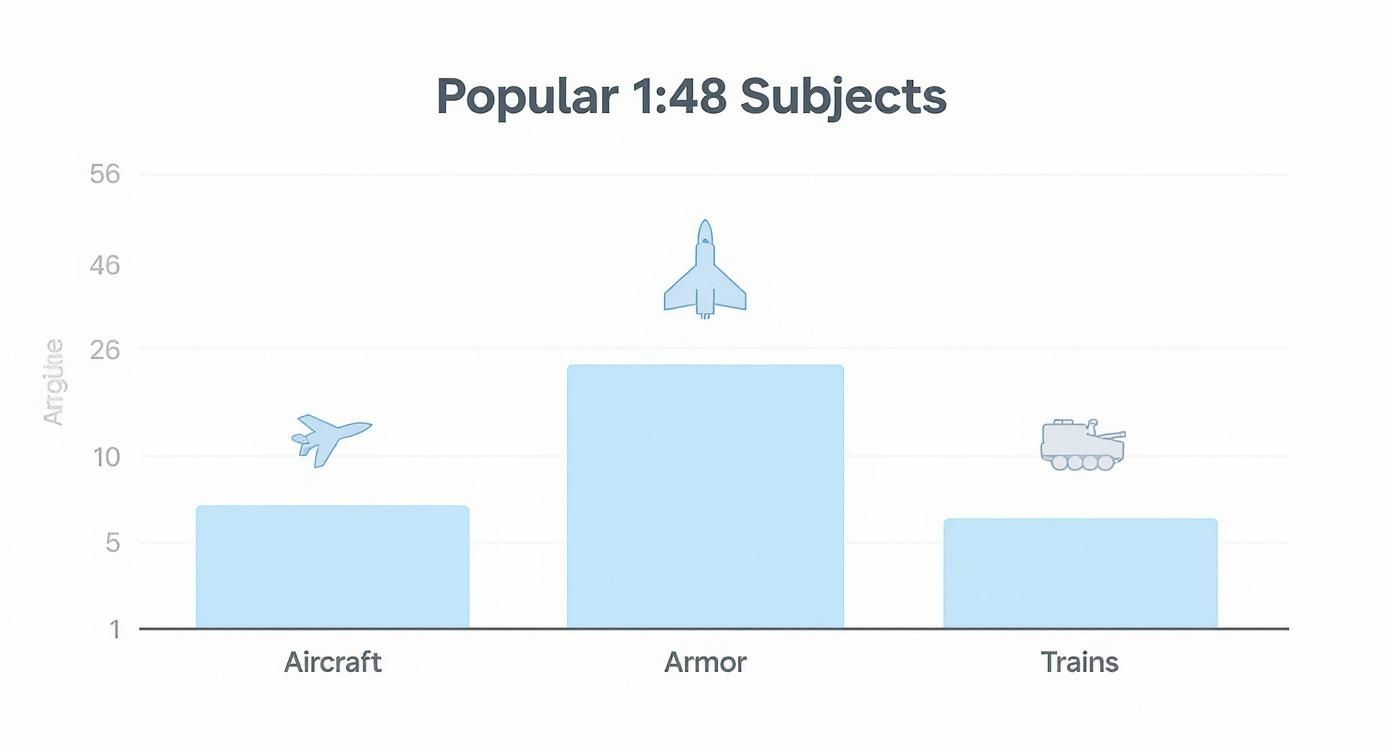
The chart makes it clear: while aircraft are king, armor and O-scale trains are major players, carving out their own huge followings within the scale.
Planning for O Scale Train Layouts
For model railroaders, 1:48 scale (known as O Scale in the US) brings its own set of challenges and rewards. The trains and buildings are substantially larger than their HO or N scale cousins, making thoughtful layout design absolutely essential for creating a believable and functional railroad.
- Track Radius is Key: O Scale trains need wide, sweeping curves to look and run right. A typical minimum radius is often 24-30 inches, which means a simple 180-degree turn can eat up a 4-5 foot wide chunk of your table. Always check the recommendations for your specific locomotives.
- Selective Compression: You can’t model a whole town 1:1, so the art of layout design is "selective compression." This means you pick which elements to model perfectly and which to shrink or suggest to create the feeling of a much larger space.
- Vertical Space Matters: Don't just build flat! Adding hills, mountains, and even multiple track levels creates huge visual interest without making the layout's footprint any bigger. Scenery can also create "view blocks" that make a small layout feel vast and mysterious.
Planning your O Scale layout is half the fun. To get more ideas on how size impacts a railroad, you can explore the different types of model trains and see how O Scale stacks up against the smaller scales.
Essential Tools and Techniques for Better Builds

Alright, let's talk shop. Getting into 1:48 scale models means having the right gear and a bit of know-how. The larger size of these kits gives you an amazing canvas for detail, but a pro-level finish starts with mastering the basics. A solid toolkit is where every great build begins.
You don't need a workshop overflowing with expensive gadgets to get started. Honestly, a handful of high-quality essentials will get you surprisingly far. These are the non-negotiables every modeler should have on their bench.
The journey from a box of plastic sprues to a jaw-dropping miniature is all about technique. It’s less about owning every tool under the sun and more about knowing how to use a few key ones really, really well.
Building Your Foundational Toolkit
Think of these as your core instruments for turning raw plastic into a clean, paint-ready model. If you invest in quality versions now, you'll be rewarded with better precision and less frustration, making the whole process more fun.
Your starter toolkit should nail two things: clean part removal and solid assembly.
- Sprue Cutters: A good pair of sharp, flush-cutting sprue cutters is your best friend. They'll snip parts from the runner without chewing up the plastic.
- Hobby Knife: A sharp hobby knife with a fresh blade is perfect for shaving off any little plastic nubs or cleaning up mold lines.
- Sanding Sticks and Files: Grab a variety of grits. These will help you smooth out seams, erase imperfections, and get surfaces prepped for glue and paint.
- Plastic Cement: Choose a quality cement that creates a strong chemical weld between parts. This isn't just glue; it fuses the plastic, making your model durable.
With just these four items, you’re equipped to handle the core construction of pretty much any 1:48 scale kit out there.
Elevating Your Finish with Advanced Painting
You can get decent results with a brush, but if you want to take a massive leap forward, an airbrush is the answer for finishing 1:48 scale models. Those large surfaces—like an aircraft's wings or a tank's hull—are notoriously tough to paint smoothly by hand. An airbrush lays down whisper-thin, even coats that won’t bury all those cool little details.
Getting that smooth, professional finish really comes down to mastering your paint. For anyone looking to level up their painting game, a deep dive into understanding how to thin acrylic paint for airbrushing is a crucial next step.
The goal is a paint consistency often compared to skim milk. This sweet spot allows the paint to flow perfectly through the airbrush, giving you a flawless finish that doesn't obscure fine panel lines and rivets.
Once your base coats are down, the real magic happens. This is where decals and weathering turn a clean, factory-fresh model into a realistic replica with a story to tell. For a detailed walkthrough, our guide on how to apply model decals has all the essential tips for a perfect finish.
Mastering Weathering for Ultimate Realism
Weathering is the art of making a model look like it's lived a life. The larger canvas of a 1:48 scale model is absolutely perfect for these techniques, as the effects have more room to breathe and look subtle rather than overdone.
Two of the most effective and beginner-friendly weathering methods are washes and dry brushing.
- Washes: This is just a very thin, dark paint mixture you flow over the model. It naturally settles into recessed areas like panel lines and around bolts, creating instant depth and shadow. It's like magic.
- Dry Brushing: This technique uses an almost-dry brush with a lighter color to gently kiss the raised details. It's perfect for making edges, bolts, and textures pop, simulating realistic wear and tear.
These skills, paired with a solid set of tools, are what will take your models from good to truly great.
Choosing the Right 1:48 Scale Model Kit
Stepping into the world of 1:48 scale models can feel like walking into a library with endless aisles. With so many manufacturers, subjects, and complexity levels, just picking the right kit is a skill in itself. Making a smart choice upfront is the key to a rewarding build that matches your skills and creative vision.
This isn't just about grabbing the box with the coolest art. A little homework on the manufacturer's reputation, the kit's engineering, and its historical accuracy can mean the difference between a frustrating project and a true masterpiece. Think of it as creating a playbook for your hobby shopping.
Evaluating Kit Manufacturers and Detail Levels
Let's be honest—not all model kits are created equal. Different brands have different philosophies, and figuring them out helps you find the right fit. Some manufacturers are famous for their razor-sharp detail and precision engineering, while others focus on providing a simpler, more affordable entry point into the hobby.
Before you buy, it's always a good idea to look up reviews of the specific kit you're eyeing. What are other modelers saying about the fit of the parts? Are the instructions clear? Is the kit known for its accuracy?
- High-End Kits: These often feature slide-molding for intricate parts, recessed panel lines, and multiple decal options. They're a fantastic choice for experienced builders looking for maximum realism.
- Beginner-Friendly Kits: Typically have a lower parts count and simpler construction, making them an excellent way to learn the fundamentals without feeling overwhelmed.
The best kit for you is one that challenges you just enough to grow your skills without causing burnout. A successful build, no matter how simple, is far more rewarding than an advanced kit left half-finished in its box.
The Power of Aftermarket Upgrades
One of the most exciting parts of building in 1:48 scale is the massive ecosystem of aftermarket parts available. These upgrades can take a basic, out-of-the-box kit and turn it into a museum-quality replica. They let you add layers of detail that injection-molded plastic just can't replicate.
Think of a standard kit as a solid foundation. Aftermarket parts are the high-end fixtures that really bring your vision to life.
Here are some of the most common upgrades:
- Photo-Etch (PE) Parts: These are thin metal sheets with incredibly fine details etched into them, perfect for things like cockpit instrument panels, seatbelts, and engine grilles.
- Resin Details: Resin casting allows for much sharper detail than plastic. You'll find highly detailed resin cockpits, ejection seats, and engine bays that drop right into your model.
- Decal Sheets: Aftermarket decals provide markings for different historical aircraft or vehicles not included in the original kit, letting you build a truly unique subject.
Special Considerations for O Scale Trains
For O Scale (1:48) railroaders, the choices go beyond just visual details and into how the model actually runs. A key decision is whether a locomotive is equipped for Digital Command Control (DCC). DCC is what allows you to control the speed, direction, lights, and sounds of each locomotive independently, even when they're on the same piece of track.
Many modern O Scale locomotives come DCC-ready, which means they have the wiring and internal space to easily add a DCC decoder later on. Others come with DCC and sound pre-installed, offering an immersive experience right out of the box with realistic engine sounds, horns, and bells. Always check the product description to see if a locomotive is DC (Direct Current), DCC-ready, or fully DCC-equipped.
Your Questions Answered: Getting Started with 1:48 Scale
Even after you've got the basics down, a few common questions always seem to pop up when modelers first jump into 1:48 scale. Let's clear up some of the most frequent queries to help you get building with confidence.
Think of this as the quick-start guide to the little details that make a huge difference.
Is 1:48 Scale the Same as O Scale?
For the most part, yes—especially if you're in the United States. American O Scale model railroading is standardized at a perfect 1:48 scale. This is fantastic news for anyone building an American-themed train layout, as it means military vehicles, civilian cars, and figures in 1:48 are a direct match.
It's worth knowing that if you venture into British or European modeling, their O Scale is a slightly different 1:43.5 scale. But for North American modelers, you can pretty much use the terms "1:48" and "O Scale" interchangeably.
What Makes 1:48 a Good Scale for Beginners?
You might think smaller is simpler, but the opposite is often true. Parts in 1:48 scale models are larger and just plain easier to handle, glue, and paint without fumbling. The bigger size also means you can actually see the fine details without needing a magnifier right away.
It’s a much more forgiving canvas when you’re learning fundamental skills like filling seams or trying weathering for the first time. You can get an impressive, detailed result that really builds your confidence, making it a brilliant gateway into the hobby.
Do I Need an Airbrush for 1:48 Models?
While you don't have to own one, an airbrush is highly recommended if you want that smooth, professional look. The large, flat surfaces on 1:48 scale models—like the wings on an airplane or the hull of a tank—are notoriously difficult to paint without leaving brush strokes.
An airbrush lays down a super-thin, even coat of paint that won't obscure all those delicate panel lines and rivets you paid for. Honestly, this one tool will elevate the finish of your model more than anything else. It's a worthy investment as you get more serious about the craft.
Ready to build your next masterpiece? Fusion Scale Hobbies has everything you need, from the latest kits to the must-have paints and tools. Check out our huge collection of 1:48 scale models and supplies at https://fusionscalehobbies.com.