


Embarking on a model railroad project is a thrilling endeavor, but the most significant challenge often lies in the very first step: deciding on a layout. The sheer number of possibilities can be paralyzing. Do you envision a vast basement empire dedicated to realistic freight operations, or do you have just enough space for a compact switching puzzle on a bookshelf? This guide is designed to cut through that complexity and provide clear, actionable starting points. We have curated 10 distinct and practical model train layout ideas, each tailored to different spaces, skill levels, budgets, and operational goals.
This comprehensive roundup moves beyond abstract concepts. For each idea, we provide a concrete blueprint to help you begin, covering essential aspects like track plan footprints, recommended scenic techniques, and specific wiring or DCC considerations. Before committing to benchwork, however, it's vital to assess your environment. Understanding the principles of effective room layout planning is crucial for maximizing your available space, ensuring your chosen design fits harmoniously whether you're working with a spare closet or a full basement.
Whether you are a seasoned modeler looking for a new challenge or a newcomer unpacking your very first starter set, you will find a plan here that resonates with your vision. Our goal is to equip you with the knowledge needed to get your project off the ground and onto the mainline. From simple display loops to intricate multi-deck designs, this list provides the inspiration and the practical details to turn your model railroading dreams into a tangible, functioning layout.
1. The Shelf Layout: Maximum Railroading in Minimum Space
When floor space is at a premium, the shelf layout emerges as one of the most effective and popular model train layout ideas. This design philosophy trades sprawling size for focused detail, creating a linear railroad that runs along a wall on a narrow shelf, typically 12 to 24 inches deep. It's an ideal solution for apartments, home offices, or bedrooms where a dedicated train room is not feasible.
The narrow footprint forces a more deliberate approach to design. Instead of a "spaghetti bowl" of track, a shelf layout excels at point-to-point operations, where trains move from one location to another with a clear purpose, such as an industrial switching district or a single-track branch line. This format is perfect for modelers who enjoy realistic operations and intricate scenery.
Implementation and Actionable Tips
To maximize the potential of a shelf layout, consider these strategies:
- Embrace a Focal Point: Don't try to cram everything in. Focus on a single, well-developed scene like a small town, a grain elevator complex, or a bustling urban freight terminal. This allows for a higher level of detail and realism.
- Create Depth with Backdrops: A seamless photo or painted backdrop is essential. It extends the scene visually, making the narrow shelf feel much deeper than it is. Integrating low-profile "building flats" against the backdrop adds to this illusion.
- Incorporate Staging: To enhance operations, include a hidden "staging yard" at one or both ends. This can be a simple set of tracks behind the backdrop or on a lower, un-scenicked shelf. This represents the "rest of the world" and allows you to swap trains in and out of the main scene.
Pro Tip: Build your shelf layout using a "domino" or modular construction method. This involves creating several small, independent sections that bolt together. This makes the layout easier to build, transport, and potentially expand in the future.
Famous examples like Lance Mindheim's urban industrial layouts or the classic "Timesaver" switching puzzle by John Allen prove that a shelf can provide hours of engaging operation. By focusing on a single, detailed scene, the shelf layout proves that you don't need a basement to build a world-class model railroad.
2. The L-Girder or Benchwork Construction Layout
For modelers moving beyond temporary setups, L-girder benchwork represents a professional-grade foundation for creating a permanent and stable model railroad. This construction method uses a robust open grid framework, typically made of wood, where L-shaped girders form the primary support. This design provides exceptional strength and rigidity, preventing sagging over time and allowing for complex, multi-level track configurations and heavy scenery.
Popularized by Linn Westcott of Model Railroader magazine, the L-girder system is revered for its versatility and accessibility. The open framework allows for easy access to all under-layout components, simplifying wiring, turnout motor installation, and maintenance. This approach is one of the most reliable model train layout ideas for anyone planning a large, permanent layout that needs to stand the test of time, making it a favorite for museum-quality exhibits and award-winning home layouts.
Implementation and Actionable Tips
To build a solid foundation using the L-girder method, focus on precision and quality materials:
- Plan Meticulously: Before cutting a single piece of wood, have a detailed plan. Ensure all measurements for legs, girders, and joists are precise to create a level and square framework. Many detailed HO scale layout plans are designed with this type of benchwork in mind.
- Prioritize Under-Table Access: Build the benchwork with enough clearance underneath, typically 3 to 4 feet, to allow you to work comfortably. Incorporate planned access hatches or "pop-ups" in areas that will be hard to reach once the scenery is in place.
- Use Quality Materials: Opt for high-quality, straight lumber (like 1x4 pine or poplar) for your girders and joists. Using clear, knot-free wood will prevent warping and ensure long-term stability for your model railroad.
Pro Tip: Construct your L-girder benchwork in modular sections, even for a permanent layout. Bolting together several 4x8-foot sections makes the initial construction more manageable in a small workshop and provides the option to move or reconfigure the layout in the future without a complete teardown.
This foundational approach is evident in the durable, portable layouts built by modular groups like the Great Lakes Proto Modular Group and is a standard for many NMRA award-winners. The video below provides a great visual overview of constructing this robust system.
3. The Switching Layout or Operations-Focused Design
For modelers who find more joy in the "why" of a train's journey than in watching it circle a loop, the switching layout is a premier choice. This design prioritizes realistic railroad operations, transforming the layout into a strategic puzzle. Instead of continuous running, the focus is on sorting cars, serving industries, and building trains, mimicking the day-to-day work of a real railroad crew.
These layouts are characterized by a complex network of industrial spurs, team tracks, and classification yards rather than a simple mainline. The goal is to move specific railcars to and from various industries according to a predetermined schedule or set of instructions. This approach offers immense satisfaction and a deep, engaging hobby experience, turning a static display into a dynamic, interactive system that can be enjoyed alone or with a group of friends.
Implementation and Actionable Tips
To build a compelling operations-focused layout, consider these key strategies:
- Study Prototype Operations: Research how real railroads handle switching in the area or era you're modeling. Understanding their procedures for sorting cars and serving customers will add incredible authenticity to your sessions.
- Use Car Cards and Waybills: Implement a system like car cards and waybills to manage your freight. Each car gets a card, and a waybill slip tells you its origin, destination, and contents. This creates a clear purpose for every move your crew makes.
- Design for Purposeful Movement: Every piece of track should have a reason for being there. Design your layout with clear origins and destinations, forcing logical and challenging switching moves to get the job done efficiently. Adopting a system like Digital Command Control (DCC) is almost essential for controlling multiple locomotives independently in a busy yard.
Pro Tip: Start with a small, manageable track plan like a classic "Inglenook" or "Timesaver" puzzle. These small-footprint designs teach the core principles of switching and operations without requiring a massive investment in space or equipment.
Pioneers like John Armstrong and modern experts like Tony Koester have championed this operational philosophy for decades. By focusing on the intricate dance of freight logistics, the switching layout provides endless challenges and a profound sense of accomplishment, proving that the most engaging model train layout ideas are often about the journey, not just the destination.
4. The Portable/Modular Layout: Your Railroad on the Road
For modelers who crave community, collaboration, or simply the ability to take their railroad with them, the portable/modular layout is an unparalleled solution. This approach involves building a layout in multiple, independent sections or "modules" that are designed to bolt together. Each module is a self-contained piece of the railroad, complete with track, scenery, and wiring, that conforms to a set of standardized dimensions and connection points.
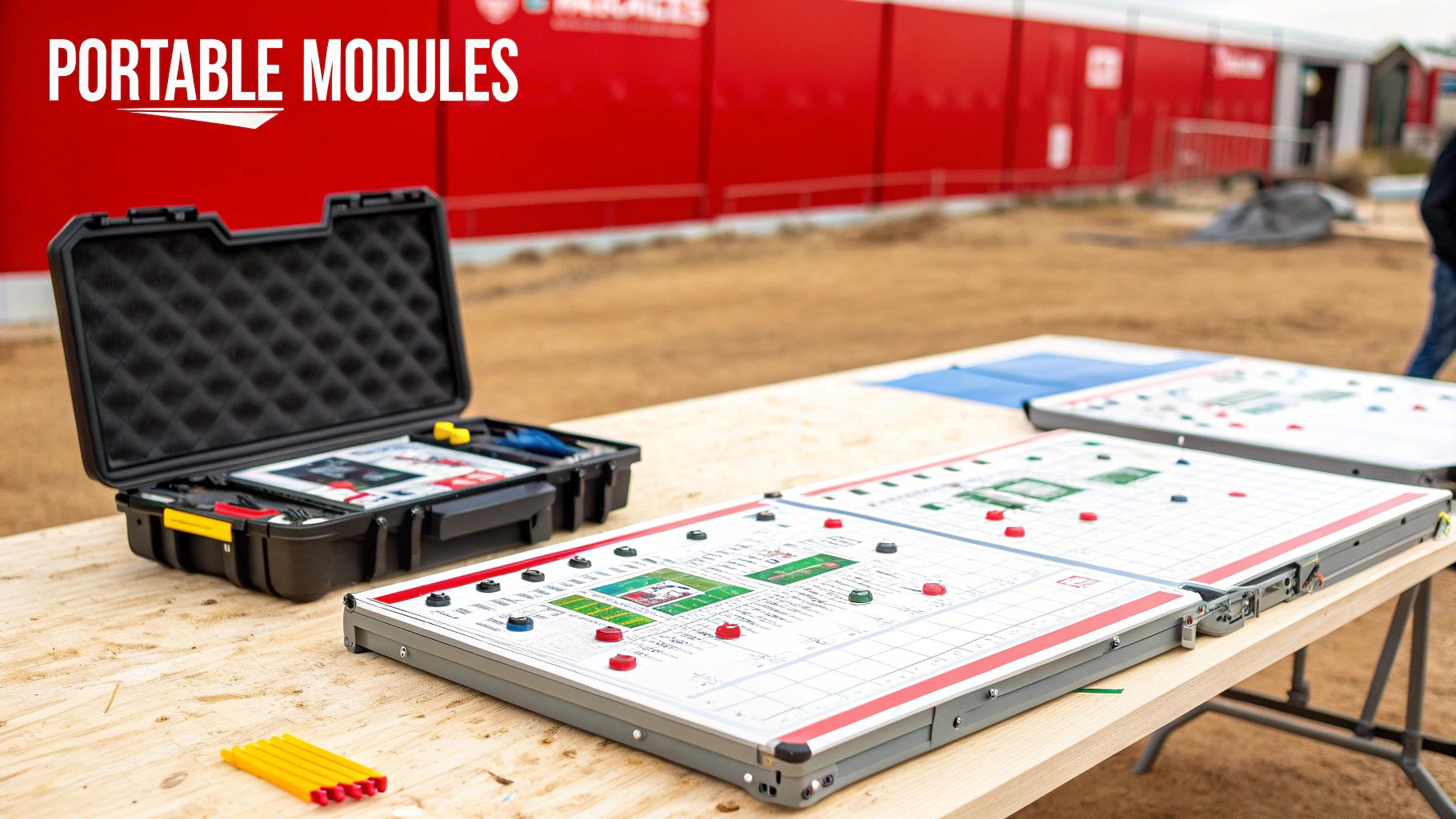
The power of modular railroading lies in its interoperability. By adhering to established standards like those from the NMRA, Free-moN, or European Fremo, a modeler can connect their module with those built by others. This allows hobbyists to participate in large, collaborative layouts at train shows and club events, creating a railroad far more extensive than one could build alone. This makes it one of the most social and dynamic model train layout ideas available.
Implementation and Actionable Tips
Building a successful module requires precision and planning. Consider these key strategies:
- Follow Standards Religiously: The entire concept hinges on modules fitting together. Whether you choose NMRA, Free-mo, or a local club standard, you must follow the specifications for module height, width, track placement, and electrical connections exactly.
- Invest in Robust Construction: Your modules will be transported, set up, and taken down repeatedly. Use high-quality, lightweight wood for the frames and protect scenery with durable materials. Secure wiring and components so they don't come loose in transit.
- Plan Your Connections: Design a clear and foolproof system for connecting modules. Use sturdy C-clamps or bolts for physical alignment and reliable plug-and-play electrical connectors (like Anderson Powerpoles) for track and accessory power.
Pro Tip: Before committing to a full scene, build a simple, un-scenicked "test module" that meets your chosen standard. Take it to a club or show to test its fit and electrical compatibility with other modules. This small step can save you major headaches later.
The sight of dozens of modules from different builders coming together to form a massive, operational railroad is a highlight of any train show. This approach not only makes the hobby portable but also fosters a strong sense of community, shared creativity, and collective achievement.
5. The Continuous-Run Display Layout
Perfect for beginners or those who simply enjoy watching trains run, the continuous-run display layout is one of the most classic model train layout ideas. This design prioritizes visual appeal and entertainment over complex operations, featuring a simple loop of track, often an oval or a figure-eight. It’s built to allow trains to run unattended for long periods, creating a dynamic and captivating moving display.
This approach is ideal for holiday setups, hobby shop windows, or as a magnificent centerpiece in a family room. The focus shifts from the intricate work of switching cars to the pure joy of seeing a beautifully detailed train glide through a finished scene. Operational complexity is intentionally minimized, making it an accessible entry point for new hobbyists and a relaxing project for seasoned modelers.
Implementation and Actionable Tips
To create an engaging display that captures attention, focus on these key elements:
- Invest in Quality Track and Power: Since the train will be running for hours, use high-quality, well-joined track and a reliable power pack or DCC system. This prevents frustrating derailments and ensures smooth, consistent performance.
- Vary Elevation and Scenery: Break up the monotony of a flat oval by incorporating gentle grades, bridges, and tunnels. This creates visual interest and makes the train's journey more compelling to watch. Surround the track with detailed scenery, buildings, and figures to bring the world to life.
- Use Lighting to Create Atmosphere: Strategic lighting can dramatically enhance the mood of your display. Add streetlights in a town scene, interior lights in buildings, and consider a day-to-night lighting cycle for a truly impressive effect.
Pro Tip: For unattended operation, ensure your locomotive and rolling stock are properly weighted and have free-rolling wheels. A little maintenance goes a long way. Regularly clean both the track and the wheels to guarantee a flawless, all-day performance.
Famous examples range from the magical Lionel layouts in department store windows to the elaborate holiday displays many families build each year. The continuous-run layout proves that the simple, elegant pleasure of watching a train circle through a miniature world is a timeless and rewarding aspect of the hobby.
6. The Point-to-Point Layout: Operations with a Purpose
Moving beyond the simple continuous loop, the point-to-point layout is one of the most immersive model train layout ideas for those who prioritize realism. This design philosophy models a railroad as a transportation system, where trains have a distinct origin and destination. Rather than circling endlessly, trains travel along a linear path from one end of the layout to the other, simulating the purposeful movement of a prototype railroad.
This linear approach is perfectly suited for modeling branch lines, industrial short lines, or specific segments of a larger railroad. The entire focus shifts from watching trains run to operating them with intent. A train might haul coal from a mine at one end to a power plant at the other, or move finished goods from a factory to an interchange yard. This creates natural, engaging operating scenarios that tell a story.
Implementation and Actionable Tips
To build a compelling point-to-point layout, focus on creating a complete, self-contained world:
- Establish Distinct Endpoints: Each end of the layout needs a logical purpose. This could be a small town, an industrial complex, a port, or a hidden staging yard representing the connection to the wider world.
- Plan Turnaround Capabilities: Since there's no continuous loop, you need a way to turn locomotives and entire trains. Incorporate a wye track, a turntable, or a reversing loop at one or both ends of the run to facilitate a return trip.
- Design for the Journey: The track between the two points is just as important as the destinations. Use curves and varied scenery to make the journey feel longer and more interesting. Include scenic highlights like bridges, tunnels, and small industries along the way to create operational interest.
Pro Tip: Study prototype railroad maps and track charts for inspiration. Noticing how real railroads serve industries and connect towns along a branch line will provide invaluable ideas for creating a believable and operationally satisfying point-to-point layout.
Pioneered by visionaries like Tony Koester and John Armstrong, the point-to-point concept proves that a layout’s purpose can be more captivating than its size. It’s an ideal choice for modelers who want to feel like they are truly running a railroad, not just a collection of trains.
7. The Multi-Level or Deck Layout
When the goal is to maximize operational potential and create distinct scenic zones within a finite footprint, the multi-level or deck layout stands out as one of the most ambitious and rewarding model train layout ideas. This design stacks two or more independent scenes vertically, connected by helixes (spiral ramps), steep "nolix" grades, or even functional train elevators. It essentially doubles or triples the mainline run in the same room space.
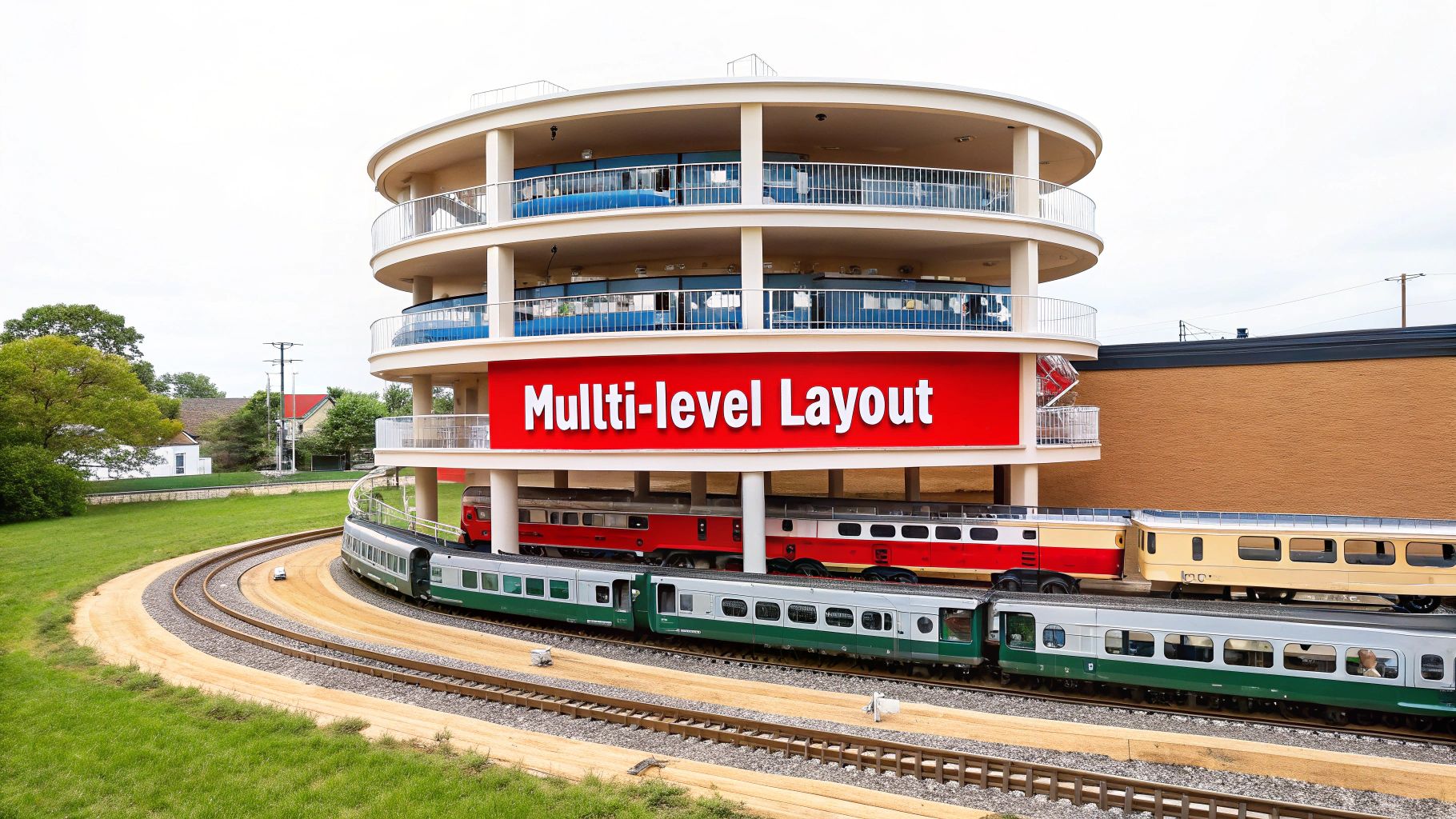
This approach is ideal for modelers who want to simulate a long-distance journey, such as a train leaving a city yard on a lower level and climbing through mountain scenery on an upper level. Each deck can represent a different town, industry, or geographical region, offering unparalleled operational variety. The vertical separation creates a strong sense of travel and purpose that is difficult to achieve on a single-level plan.
Implementation and Actionable Tips
Building a successful multi-level layout requires careful planning and robust construction. Consider these strategies:
- Plan Your Connections: The helix is the most common method for connecting levels, but it consumes significant space. Carefully calculate its radius (HO scale typically requires at least a 24-inch radius) and grade (aim for 2% or less). For tighter spaces, a staging elevator or a lift-out "cassette" can serve the same purpose.
- Prioritize Lighting: The lower level can easily become a dark cavern. It is crucial to integrate high-quality LED strip lighting under the upper deck to illuminate the scene below. This ensures the lower level is just as visually appealing and operable as the top one.
- Build Strong Benchwork: A multi-level layout carries significant weight. Use sturdy L-girder or open-grid benchwork constructed from high-grade plywood or dimensional lumber to prevent sagging over time. Ensure there is adequate clearance (at least 12-16 inches) between levels for access and viewing.
Pro Tip: Use color-coded wiring for each level. Assigning a specific color for track power, turnouts, and accessories on the upper deck and a different set of colors for the lower deck will simplify troubleshooting and future DCC installations immensely.
Pioneered by modelers like Tom Lipton and frequently featured in Model Railroader Magazine, multi-deck layouts are the ultimate expression of maximizing a given space. By building up instead of out, they offer a way to create a railroad empire that feels vastly larger than the room it occupies.
8. The Narrow Gauge or Prototype-Specific Layout
For modelers who are passionate about history and authenticity, the prototype-specific layout offers a deeply rewarding challenge. This approach moves beyond generic model train layout ideas to focus on faithfully recreating a specific, real-world railroad, often a narrow gauge line. By modeling in scales like On30 or HOn3, enthusiasts can capture the unique character and rugged charm of lines like the Denver & Rio Grande Western or the East Broad Top.
This design philosophy prioritizes accuracy above all else. Every locomotive, freight car, structure, and scenic element is carefully chosen to match historical records and photographs of the chosen prototype. The goal is to build a functional, operating time capsule that tells the story of a specific railroad in a particular era, making it an ideal pursuit for modelers who are also historians at heart.
Implementation and Actionable Tips
To succeed with a prototype-specific or narrow gauge layout, deep research and precision are key:
- Become an Expert: Immerse yourself in the history of your chosen railroad. Invest in reference books, track diagrams, and historical photos. This documentation will be the blueprint for your entire layout, from track arrangements to building paint colors.
- Source Accurate Models: Seek out kits and ready-to-run models that are correct for your prototype. Joining a specialty group or club dedicated to your railroad can be an invaluable source for locating rare models and sharing knowledge.
- Prioritize Operations: Study the real railroad's operating procedures. Replicating its typical train movements, switching patterns, and schedules will bring your layout to life and provide a much more engaging experience than simply running trains in a loop. For a deeper understanding of the different scales involved, you can learn more about model railway scales here.
Pro Tip: Use Sanborn fire insurance maps or old topographical maps to accurately model the track arrangements and building placements in a specific town or industrial area. These historical documents provide an incredible level of detail that can elevate your layout's realism.
Famous examples found in publications like the Narrow Gauge and Short Line Gazette demonstrate the incredible level of detail and historical storytelling possible with this approach. By focusing on a single prototype, modelers can create a layout that is not just a collection of trains, but a true homage to railroad history.
9. The Interactive or Educational Layout
Moving beyond the private basement, some of the most rewarding model train layout ideas are those designed for public engagement. The interactive or educational layout is built to capture the imagination of a broad audience, often found in museums, science centers, or public exhibitions. Its primary purpose is to teach, entertain, and inspire, using the model railroad as a dynamic, three-dimensional storytelling tool.
These layouts prioritize durability, visitor participation, and clear educational themes over complex, prototypical operations. The design focuses on showcasing specific concepts, whether it's the history of a local railroad, the science of transportation, or simply the joy of making a train move. From the Smithsonian's extensive displays to interactive exhibits at children's museums, these layouts serve as powerful ambassadors for the hobby.
Implementation and Actionable Tips
To create a successful public-facing layout, the design philosophy must shift from personal enjoyment to user experience:
- Design for Durability: Public layouts endure significant wear and tear. Use robust benchwork, high-quality track, and simple, sturdy scenery. Secure all scenic elements and protect delicate models with plexiglass barriers where necessary.
- Intuitive Visitor Controls: Replace complex DCC throttles with simple, push-button controls. Allow visitors to activate animations, trigger sound effects (like a horn or station announcement), or start a train on a simple loop. Clear, concise signage is crucial to guide their interaction.
- Focus on a Clear Narrative: Each scene should tell a story or explain a concept. Use signs, graphics, and even audio narration to explain what visitors are seeing, such as the function of a grain elevator or the process of coupling cars.
Pro Tip: Build with maintenance in mind. Use terminal re-railers and easy-access panels for wiring and hard-to-reach track. Design the layout so that a single component failure, like a stalled locomotive, doesn't shut down the entire exhibit.
Layouts created for public interaction offer a unique way to share a passion for model railroading with the community. By focusing on robustness, clear educational goals, and user-friendly controls, these displays can create lasting memories and inspire the next generation of hobbyists.
10. The Freelanced or Fantasy Layout: Your Railroad, Your Rules
For the modeler who values creative freedom above all, the freelanced or fantasy layout is the ultimate canvas for self-expression. This approach liberates you from the constraints of historical accuracy, allowing you to build a railroad that exists only in your imagination. Instead of recreating a specific prototype, you invent your own railroad company, its history, its operational purpose, and the world it serves.
This concept can range from a plausible "what-if" railroad that logically connects two real-life lines, to a complete fantasy world with unique industries and whimsical scenery. The freelanced approach is one of the most popular model train layout ideas because it allows you to combine your favorite elements from different prototypes, eras, and regions into a single, cohesive, and deeply personal creation. It's a perfect fit for hobbyists who want to tell their own unique story.
Implementation and Actionable Tips
To build a believable and engaging freelanced world, a bit of planning goes a long way:
- Develop a Clear Backstory: Why does your railroad exist? What does it haul, and where? Creating a simple narrative, even just a paragraph, provides a guiding principle for all your design choices, from locomotive paint schemes to the types of industries you model.
- Establish a Consistent Aesthetic: While you have total freedom, consistency is key to a believable layout. Decide on a unique color scheme, logo, and lettering style for your railroad's locomotives and rolling stock. This visual identity will tie the entire scene together.
- Borrow from Prototypes: The best freelanced layouts feel plausible because they are grounded in reality. Research real-world railroad practices, equipment, and structures for inspiration. You can then adapt these elements to fit your fictional universe.
Pro Tip: Create a "company handbook" or style guide for your fictional railroad. Document your decisions on things like paint colors, heraldry, numbering schemes, and operational rules. This will ensure your layout remains consistent as it grows and evolves over time.
Legendary modelers like John Allen with his "Gorre & Daphetid Railroad" proved that a freelanced concept can be just as compelling, if not more so, than a strict prototype model. By building your own world, you ensure your layout is truly one-of-a-kind.
Comparing 10 Model Train Layout Ideas
| Layout | Implementation 🔄 (Complexity) | Resources ⚡ (Space / Cost / Skills) | Expected Outcomes 📊 / ⭐ (Impact / Quality) | Ideal Use Cases 💡 | Key Advantages ⭐ |
|---|---|---|---|---|---|
| The Shelf Layout | Low 🔄 — simple benchwork, easy access | Low ⚡ — small footprint, modest cost, basic tools | 📊 Good visual display; limited ops — ⭐⭐ | Small apartments, beginner displays, collectors | Space-efficient, low cost, easy incremental expansion |
| L‑Girder / Benchwork Construction | High 🔄 — precise woodworking/metalwork, time‑consuming | High ⚡ — larger materials, workshop skills, higher cost | 📊 Professional stability and realism — ⭐⭐⭐⭐⭐ | Serious hobbyists, permanent museum or club layouts | Extremely rigid, precise grades, excellent for detailed scenery |
| Switching / Operations‑Focused | Medium‑High 🔄 — complex track and wiring for ops | Medium‑High ⚡ — significant space, complex wiring, more rolling stock | 📊 Deep operational engagement; prototypical running — ⭐⭐⭐⭐ | Operating sessions, clubs, enthusiasts focused on realism | Realistic yard/switching play, social and educational value |
| Portable / Modular | Medium 🔄 — standardized joins, repeatable assembly | Medium ⚡ — per‑module cost, storage, transport considerations | 📊 Flexible exhibition value; interoperable — ⭐⭐⭐⭐ | Shows, traveling clubs, modular club meets | Transportable, expandable, compatible with standards |
| Continuous‑Run Display | Low 🔄 — simple layout, easy automation | Low‑Medium ⚡ — small to moderate space, can be low cost | 📊 High visual/entertainment impact; limited ops — ⭐⭐⭐ | Retail displays, beginners, unattended running | Easy to operate, spectator friendly, low maintenance |
| Point‑to‑Point | Medium 🔄 — linear planning, reversing mechanisms | Medium ⚡ — needs linear space or staged ends, moderate cost | 📊 Strong narrative realism; operator‑driven — ⭐⭐⭐⭐ | Prototype branch lines, storytelling layouts, realistic ops | Natural end‑to‑end operation, excellent scenic opportunities |
| Multi‑Level / Deck | High 🔄 — complex vertical engineering, helix design | High ⚡ — more materials, sturdy benchwork, complex wiring | 📊 Maximizes visible trackage; striking visuals — ⭐⭐⭐⭐ | Medium to large rooms where footprint is limited vertically | Great space efficiency, long runs, distinct scenic zones |
| Narrow Gauge / Prototype‑Specific | Medium‑High 🔄 — specialized modeling and research | High ⚡ — specialized equipment, kitbuilding, research time | 📊 High authenticity and historical value — ⭐⭐⭐⭐ | Historians, prototype specialists, museum replicas | Deep authenticity, unique aesthetic, specialist community |
| Interactive / Educational | Medium 🔄 — robust design for public use, safety needs | Medium‑High ⚡ — durable materials, staffing, signage | 📊 High engagement and outreach; educational impact — ⭐⭐⭐⭐ | Museums, schools, public exhibits, outreach programs | Visitor‑friendly, educational, promotes hobby outreach |
| Freelanced / Fantasy | Low‑Medium 🔄 — flexible build, creative planning | Medium ⚡ — variable cost, focus on custom details | 📊 High creative expression; subjective appeal — ⭐⭐⭐ | Personal home layouts, themed exhibits, creative showcases | Complete creative freedom, low research burden, unique identity |
Your Next Layout is Waiting
The journey from a simple idea to a fully realized model railroad is one of the most rewarding experiences in the hobby. We've explored a diverse range of model train layout ideas, from the space-saving brilliance of a shelf layout to the operational complexity of a multi-deck system. Each concept, whether it's a portable modular design for club meets or an immersive freelance world born from your imagination, offers a unique pathway into this captivating pastime. The common thread weaving through all these possibilities is the fundamental principle of planning: your success begins long before the first piece of track is laid.
The most critical takeaway is that there is no single "best" layout design, only the one that is best for you. Your available space, budget, time commitment, and personal interests are the true architects of your future railroad. A meticulously planned switching layout in a spare closet can provide just as much satisfaction as a sprawling basement empire if it aligns with your goals. The key is to make an honest assessment of your resources and aspirations.
From Inspiration to Actionable Plan
Moving forward, the goal is to transform this inspiration into a tangible plan. Don't let the sheer number of options lead to "analysis paralysis." Instead, use these ideas as a toolkit. You can mix and match concepts to create a truly personalized design.
- Combine a Shelf and a Point-to-Point Layout: Create a long, narrow scene that focuses on the journey between two key locations, perfect for a prototype-inspired branch line.
- Integrate Switching into a Continuous Run: Add a small industrial spur or a complex yard within a larger loop to get the best of both scenic running and operational challenges.
- Build a Modular, Multi-Level Layout: Design each module as a self-contained scene that can connect with others, with some modules featuring different elevations for vertical interest.
Think of your first layout, or your next one, as a learning experience rather than a final masterpiece. Every project hones your skills in benchwork, track laying, wiring, and scenery. Starting with a smaller, more manageable project like a portable switching puzzle is an excellent way to build confidence and develop techniques that you can apply to more ambitious plans later. The skills gained from building a simple display loop are directly transferable to a more complex L-girder benchwork project.
The True Value of a Well-Chosen Layout
Ultimately, mastering the art of selecting and planning a layout is about more than just building a model; it's about creating a sustainable and enjoyable hobby for yourself. A well-chosen plan prevents burnout, manages budget expectations, and ensures that the time you invest yields a result you can be proud of. It turns a potential source of frustration into a consistent source of relaxation, creative expression, and technical achievement.
The layout is the stage upon which all other aspects of the hobby play out. It's the reason you meticulously weather a freight car, install a new DCC sound decoder, or spend an evening perfecting a patch of static grass. Your layout gives context and purpose to every other model and project. Whether your passion lies in precise historical replication or imaginative world-building, your layout is the physical manifestation of that vision. The perfect plan is out there, waiting for you to clear a space, pick up a pencil, and begin the exciting process of bringing it to life.
Ready to turn your chosen layout idea into reality? Fusion Scale Hobbies is your one-stop source for everything you need, from Kato Unitrack and Woodland Scenics materials to the latest DCC systems from SoundTraxx and NCE. Start your build today by exploring our extensive collection of high-quality model railroading supplies at Fusion Scale Hobbies.