

If you've ever felt drawn to the impressive size and classic charm of certain model trains, chances are you were looking at O scale. Built to a commanding 1:48 scale, these locomotives are exactly 1/48th the size of the real thing, making them one of the oldest and most beloved standards in the hobby.
Your Starting Point for O Scale Trains
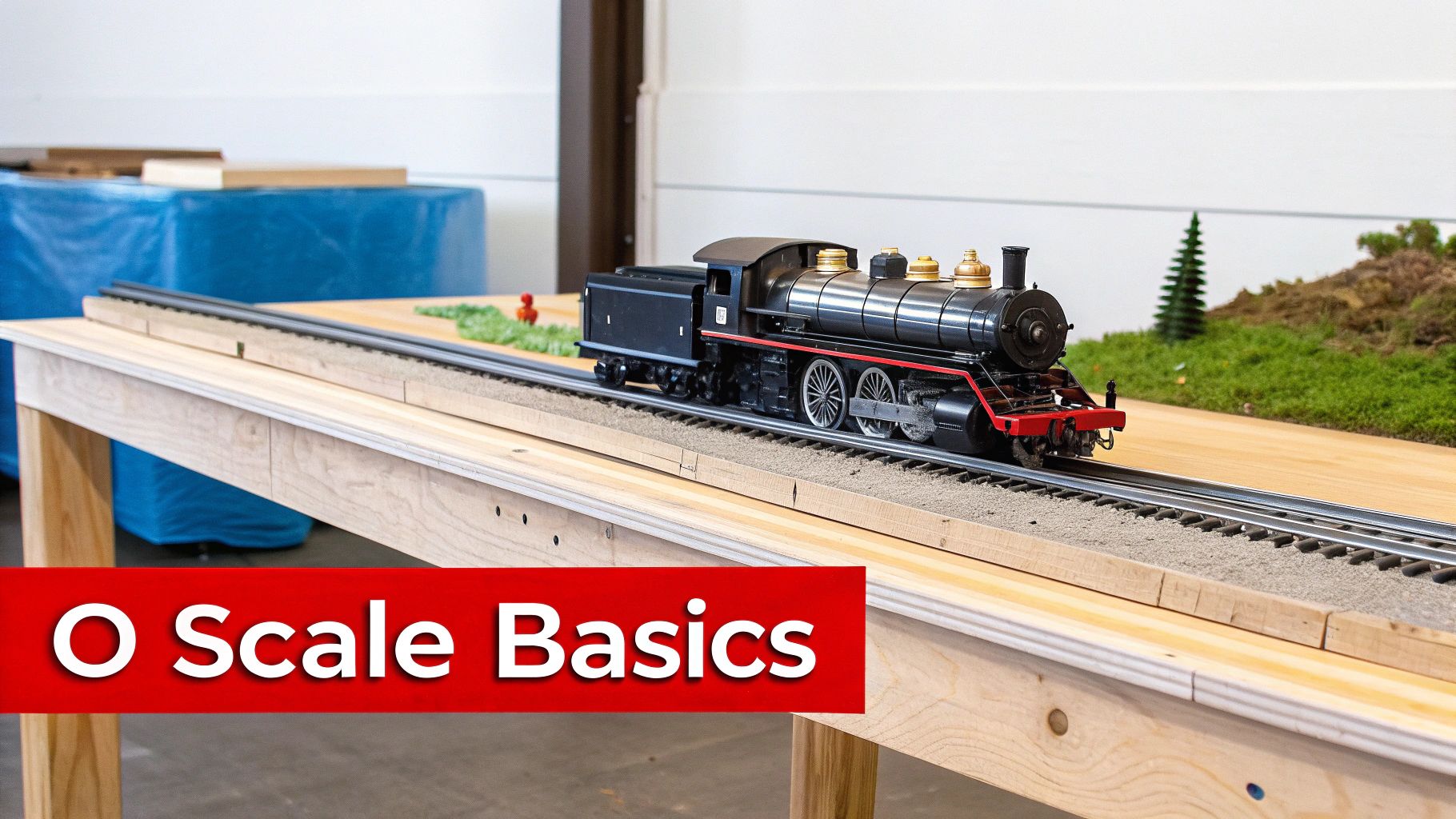
Jumping into the world of O scale is an exciting move, but it almost always starts with a couple of key questions. What's the big deal with this particular scale? The magic lies in its perfect balance of substantial presence and intricate detail, making it a long-time favorite for everything from sprawling basement layouts to the classic train circling the Christmas tree.
To get your bearings, we need to clear up two fundamental terms that often get mixed up: scale and gauge.
- Scale is all about the model's proportional size compared to its real-world counterpart. For American O scale, that ratio is a precise 1:48.
- Gauge, on the other hand, is much simpler—it’s just the distance between the two running rails on the track. For standard O gauge, this is 1.25 inches.
Think of it this way: scale defines the size of your train, while gauge defines the road it runs on. Getting these two straight is the first and most important step to building a layout that looks right and runs smoothly. For a closer look at how O compares to other popular sizes, check out our complete guide to model railway scales.
To quickly summarize these core concepts, here's a handy table.
O Scale At a Glance
| Attribute | Description |
|---|---|
| Scale Ratio | 1:48 (American Standard) |
| Track Gauge | 1.25 inches (distance between rails) |
| Key Feature | Large size allows for impressive detail and presence. |
| Common Use | Ideal for both detailed, realistic layouts and traditional toy train setups. |
This table gives you the essential DNA of O scale—it's big, detailed, and has a track standard that has been around for generations.
A Rich and Storied History
A huge part of O scale's appeal comes from its deep roots. Its history stretches all the way back to the early 20th century when it emerged as a popular standard that offered incredible detail without being too massive for home layouts.
Industry giants like the Lionel Corporation were instrumental in popularizing the scale in the 1920s, cementing its place as a dominant force in the hobby. Its popularity is still especially strong in North America, where its larger size feels perfectly suited for capturing the grand, powerful spirit of American railroading.
The enduring charm of O scale lies in its heritage and physical presence. It’s large enough to appreciate the fine details of a steam engine’s valve gear or a diesel’s livery, yet it still fits within a dedicated room or basement, offering a truly immersive experience.
Choosing Your Control System: DC vs. DCC
So you've decided to dive into the exciting world of O scale. Awesome. Now comes your next big decision: how are you going to power and control your locomotives? This really boils down to two different philosophies: the old-school reliability of Direct Current (DC) versus the modern flexibility of Digital Command Control (DCC). Getting your head around the difference is key to building a layout you'll actually enjoy running.
Think of your layout's wiring like the lights in your house. DC is like a classic dimmer switch on the wall. You turn it up, and every single light on that circuit gets brighter. You turn it down, they all dim together. You can't just brighten the lamp in the corner while leaving the overhead light off; they're all tied to that one control.
DCC, on the other hand, is like a modern smart home system. You can pull out your phone and tell the kitchen light to turn on, the living room lamp to dim to 50%, and the hallway light to stay off. They all get power from the same electrical panel, but you can talk to each one individually. That’s the magic of DCC in a nutshell.
The Simplicity of Direct Current
Direct Current, which you'll often hear called "conventional" control, is the way model trains have been run for decades. The concept is beautifully simple: the speed and direction of your engine are tied directly to the electricity flowing through the track.
- More Voltage: The train goes faster.
- Less Voltage: The train slows down.
- Flip the Polarity: The train changes direction.
The system is elegant and dead simple. The wiring is straightforward, and the power pack is intuitive to use. If you're just starting out with a basic loop of track and a single O scale locomotive, DC is a fantastic, budget-friendly way to get up and running without any technical headaches.
The big catch with DC shows up the moment you want to run a second train. Since every locomotive on the track gets the same electrical command, they'll all start and stop together. To control another engine on its own, you have to create an electrically separate "block" of track with its own controller. On a big layout, this can turn into a real spaghetti monster of wiring.
The Power of Digital Command Control
Digital Command Control, or DCC, completely rewrites the rulebook. Instead of tweaking the voltage on the track, a DCC system sends a constant, full-power digital signal to the rails at all times. The real work happens inside a tiny computer chip, called a decoder, that you install in each locomotive.
Every decoder gets a unique address, kind of like a street number for each house. Your DCC throttle sends out little digital messages down the rails, and each message is addressed to a specific engine. Only the locomotive with the matching address will listen and follow the command—whether you're telling it to speed up, hit the brakes, turn on its headlight, or blast the horn.
This gives you an incredible amount of freedom. You can have multiple O scale locomotives on the very same piece of track, all doing different things. One engine can be chugging up a grade with a long freight train, another can be sitting idle in a siding with its lights on, and a third can be shunting cars in the yard—all at the same time, on the same circuit.
Want to go deeper into how it all works? Our comprehensive guide to Digital Command Control for model trains breaks down the technology and what it can do for your layout.
Comparing DC and DCC for Your Layout
So, which one is right for you? It really comes down to balancing your budget, how complex you want things to get, and what your long-term plans are for your O scale empire.
| Feature | Direct Current (DC) | Digital Command Control (DCC) |
|---|---|---|
| Train Control | One train per electrical block | Multiple trains controlled independently on the same track |
| Wiring | Simple for small loops, but gets complex with multiple blocks | Simpler track wiring for large layouts, but needs decoder installation |
| Initial Cost | Lower; basic power packs are very affordable | Higher; you'll need a command station, boosters, and decoders |
| Features | Basic speed and direction control | Individual control of speed, direction, lights, sound, and other effects |
| Realism | Limited operational realism | A high degree of realism, allowing for prototypical operations |
Making Sense of Locomotive Types and Wheels
When you first dive into O scale locomotives, you're doing more than just buying models—you're collecting little pieces of railroad history. The variety can feel overwhelming at first, but most engines boil down to three main categories: steam, diesel, and electric. Each one tells the story of a different chapter in railroading, from the raw, mechanical power of the early days to the sleek efficiency of the modern era.
Picking a locomotive isn't just about what looks cool on the shelf. It’s about deciding what kind of railroad you want to create. Are you captivated by the romantic age of steam, with its intricate machinery and plumes of smoke? Or do you lean toward the workhorse reliability of the mid-century diesels that completely transformed American freight?
This infographic gives you a quick visual breakdown of the two main control systems, DC and DCC, which dictate how you'll run these different engines on your layout.
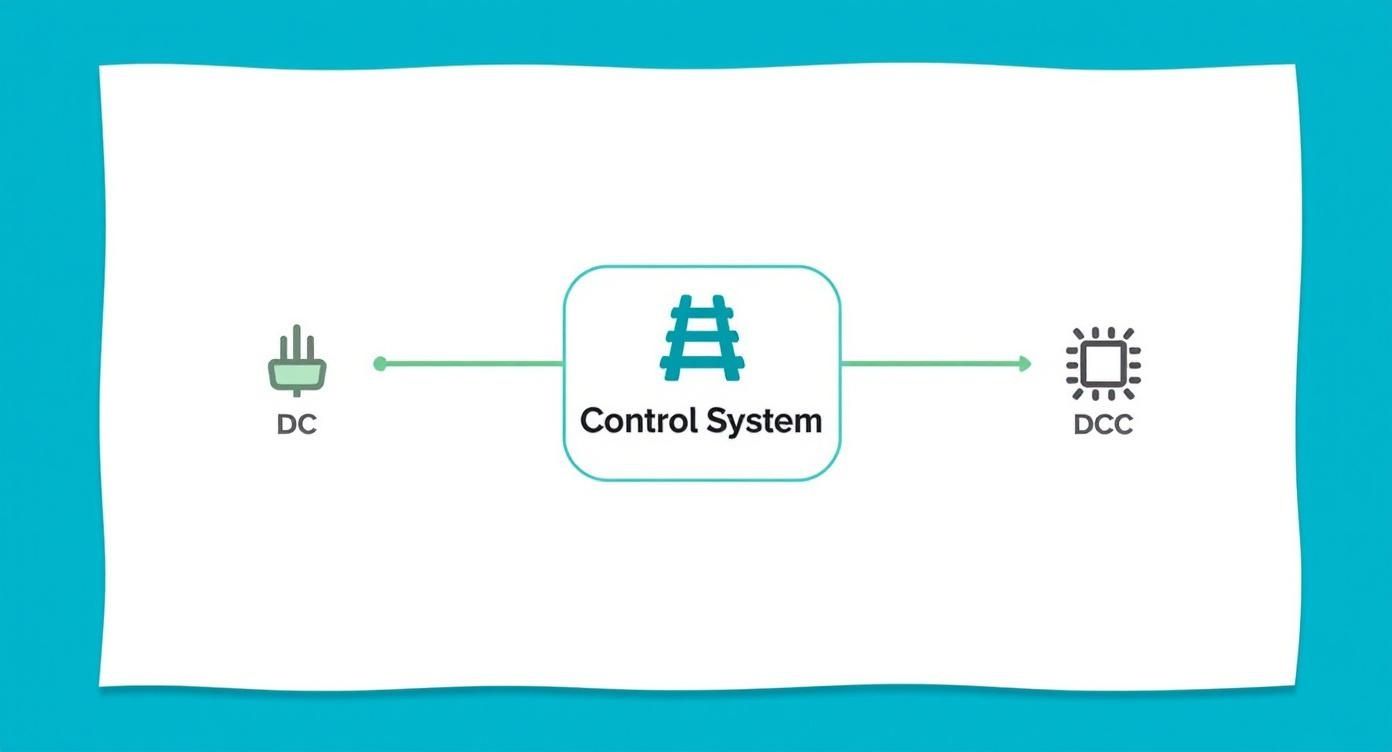
It clearly shows the difference between the straightforward power of DC and the smarter, individual command structure of DCC—a fundamental choice every modeler has to make.
Decoding Steam Locomotive Wheels
Steam engines are often the heart and soul of a model railroad, and their identity is all in the wheels. To classify them, hobbyists use the Whyte notation system, a simple set of three numbers that tells you everything you need to know about a steam locomotive's job.
Think of it like a quick formula: Leading Wheels - Driving Wheels - Trailing Wheels.
- Leading Wheels: These are the smaller, unpowered wheels at the very front. They're like guides, helping the massive engine navigate curves and track switches without derailing.
- Driving Wheels: These are the big, powered wheels connected to the pistons with side rods. They are the engine's muscles, digging in to provide the traction and pull the train.
- Trailing Wheels: Tucked under the cab at the rear, these smaller wheels support the heavy firebox and crew, which allows for a bigger, more powerful boiler.
So, when you hear about a famous "Pacific" type locomotive being a 4-6-2, you instantly know its setup: four leading wheels, six driving wheels, and two trailing wheels. That configuration was absolutely perfect for high-speed passenger trains.
Understanding the Whyte notation is like learning to read a locomotive's resume. A high number of drivers (like an 8 or 10) usually means it was a heavy freight hauler, while fewer drivers and more leading wheels suggest a faster passenger engine.
Common Steam Locomotive Examples
Knowing a few of the classic wheel arrangements will help you spot different engines and understand what they were built to do. Here are some of the icons you'll find in O scale:
| Whyte Notation | Common Name | Primary Use |
|---|---|---|
| 4-6-2 | Pacific | Fast Passenger Trains |
| 2-8-2 | Mikado | Heavy Freight |
| 4-8-4 | Northern | Dual-Service (Freight & Passenger) |
| 0-6-0 | Switcher | Yard Work & Shunting |
This system makes identifying and collecting o scale locomotives much easier. It lets you build a fleet that’s historically right for the railroad and time period you want to bring to life.
The Rise of Diesel and Electric Power
As technology marched on, steam eventually gave way to the efficiency of diesel-electric and fully electric locomotives. These engines are classified more by their model numbers (like an EMD F7 or a GE Dash 9) and what they were built for. You'll find a massive range of diesel models out there, from the early streamlined "covered wagons" to today's high-horsepower freight beasts.
The love for railroading, especially in North America, keeps the market for all types of models strong. This is mirrored in the full-size global locomotive market, where North America has consistently held a 31-34% market share in recent years. This regional passion for real trains is what fuels the vibrant O scale hobby, ensuring we get a steady stream of new and exciting models. You can discover more about the global locomotive market's regional trends on Fortune Business Insights.
Whether you end up choosing the mechanical wonder of a steam engine or the streamlined power of a diesel, understanding these basics is your first step toward building an authentic and captivating model railroad.
How to Choose the Right Manufacturer and Model
Walking into the world of O scale locomotives can feel a lot like visiting a massive car dealership. You’ve got dozens of brands and even more trim levels, each with its own quirks and features. Not all engines are created equal, and figuring out the differences between manufacturers like Lionel, MTH, and Atlas is the key to finding a locomotive that fits your layout, your goals, and your budget.
Making the right choice from the get-go means you’ll end up with an engine you’ll actually enjoy for years to come. The big names in O scale all offer distinct product lines, ranging from fun, entry-level models to museum-quality replicas for the most serious collectors. Your first job is to decide what you really want out of your locomotive.
Toy versus Scale The First Big Decision
The biggest fork in the road you'll hit is the choice between "Traditional" (or "Toy") models and true "Scale" models. This isn't really about quality—it's about philosophy. The difference is pretty simple:
-
Traditional/Toy Grade: These locomotives are built for fun and built to last. They often have slightly squashed proportions so they can handle the super-tight curves (like O-27 or O-31 track) you find in starter sets and holiday displays. They're fantastic for beginners, families, or anyone who just loves the classic, nostalgic vibe of toy trains.
-
Scale Grade: These models are crafted to be exact 1:48 scale replicas of the real thing. They are packed with incredible detail, from separately applied handrails to tiny rivet patterns, and they need much wider curves to run properly. These are aimed squarely at serious modelers who are all about realism and historical accuracy.
A lot of manufacturers offer a happy medium, often called something like "Proto-Scale" or "RailKing." These models give you scale-like details on a chassis that can still navigate tighter curves. It's a "best of both worlds" approach that's become incredibly popular because you get great looks without needing a gymnasium-sized layout to run it.
The choice between toy and scale directly impacts the look, performance, and cost of your O scale locomotives. A traditional engine might cost under $200, while a high-end scale model with premium sound and smoke effects can easily exceed $1,000.
Comparing O Scale Model Grades
To make this even clearer, let's break down what you get with each grade. Think of it like choosing a car—are you looking for a reliable daily driver, a tricked-out sports car, or something in between?
| Model Grade | Target Audience | Key Features | Typical Price Range |
|---|---|---|---|
| Toy/Traditional | Beginners, Families, Holiday Layouts | Durable construction, compressed proportions, runs on tight curves (O-27/O-31), basic sound and light effects. | $100 - $300 |
| Scale | Serious Hobbyists, Collectors | Precise 1:48 scale, high detail (rivets, handrails), requires wide curves (O-54+), advanced DCC/sound systems. | $600 - $1,500+ |
| Proto-Scale | Intermediate Modelers, Those with limited space | Scale-like details on a traditional chassis, can handle tighter curves (O-31/O-36), often includes good sound and smoke features. | $300 - $800 |
This breakdown should help you pinpoint exactly where you fit in. There's no right or wrong answer—it's all about what makes the hobby enjoyable for you.
Navigating the Big Brands
Once you know what grade of model you're after, you can start exploring the brands. Each has its own reputation and specialties, which helps narrow the field. For a much deeper look, our guide on the best model train brands is a great resource.
The model train market is a surprisingly big deal, valued at around USD 1.18 billion and on track to nearly double by 2033. O scale carves out a unique niche within this industry, with about 8% of modelers choosing it for that perfect blend of impressive size and fine detail. While it’s not as massive as HO scale, this dedicated community ensures we get a steady stream of fantastic new products from the top manufacturers. If you're a data nerd, you can read the full market research from Business Research Insights.
Getting familiar with the different product lines from these brands is your next step.
Manufacturer Lineup At a Glance
Here’s a simple cheat sheet showing how each of the major brands categorizes their O scale offerings. This will help you find the right tier for your layout and budget.
| Manufacturer | Entry-Level Line | Mid-Range/Semi-Scale | High-End Scale Line |
|---|---|---|---|
| Lionel | Traditional O Gauge | LionChief / FlyerChief | Legacy / Vision Line |
| MTH | RailKing | RailKing | Premier |
| Atlas | Atlas O Trainman | N/A | Atlas O Master |
For example, if you want a highly detailed diesel but your layout is on the smaller side, MTH’s RailKing line is a fantastic place to start. On the other hand, if you're building a top-tier, historically perfect steam-era masterpiece, you'll be shopping in the Atlas Master or Lionel Legacy lines.
At the end of the day, picking the right manufacturer and model is all about matching your personal goals with what’s out there. Think hard about your budget, the space you have, and just how much realism matters to you. Once you understand these key differences, you can confidently choose O scale locomotives that will be the stars of your railroad.
An O scale locomotive is a beautiful piece of machinery, but just like its real-life counterpart, it needs a little routine care to perform its best. The secret to years of reliable, fun operation isn't complicated—it's just consistent, simple maintenance. Honestly, it's far less intimidating than it sounds.
Think of your locomotive like a high-performance car. You wouldn't drive it for thousands of miles without changing the oil or checking the tires, right? The same logic applies here. A few minutes of preventative care can save you from a frustrating operating session and help you avoid costly repairs down the road.
This guide will walk you through the essential maintenance tasks and troubleshooting steps to keep your O scale fleet in peak condition. These are straightforward jobs that any hobbyist can master with a few basic tools and a little patience.
Essential Maintenance Checklist
The foundation of a smooth-running railroad is clean power and a well-lubricated mechanism. If you can get that right, you've solved 90% of potential problems. Electrical pickup and mechanical friction are the two biggest culprits affecting performance, so that's where we'll focus our efforts.
A simple maintenance routine really just boils down to three key areas:
- Cleaning Wheels and Track: This is non-negotiable. Dirty wheels and rails are the #1 cause of flickering lights, stuttering sound, and poor motor performance.
- Strategic Lubrication: A little bit of the right oil and grease on gears and moving parts reduces wear and ensures quiet, efficient operation. The key word here is little—too much is just as bad as too little.
- Visual Inspections: Giving your engine a quick once-over to check couplers, wires, and pickup rollers can help you spot a small issue before it turns into a major failure.
A clean connection is everything in model railroading. Even a microscopic layer of dirt or oxidation on your track or wheels can interrupt the flow of electricity, causing your multi-hundred-dollar locomotive to stall and sputter.
Step-by-Step Care Instructions
Getting hands-on with your locomotives is the best way to learn. Let's walk through a practical, step-by-step process for these crucial maintenance tasks.
For Cleaning Wheels:
- Grab a soft, lint-free cloth or a cotton swab and lightly dampen it with isopropyl alcohol. 90% or higher is best.
- Gently rub the tread of each wheel until you don't see any more black residue coming off.
- For really stubborn grime, a specialized track cleaning block or a fine abrasive stick can be used, but use it sparingly.
For Lubrication:
- Apply a tiny drop of hobby-specific light oil to the axle points where they meet the locomotive's frame.
- Use a small amount of plastic-compatible grease on the main worm gear and any other visible gearing. A toothpick is the perfect tool for applying it precisely.
- Remember, less is more. Over-oiling is a classic rookie mistake that just attracts dirt and gunks up the whole mechanism.
Troubleshooting Common Locomotive Problems
Even with perfect maintenance, things can still go wrong. Don't panic—most problems have simple solutions. Running through a quick diagnostic checklist will almost always pinpoint the cause and get your engine back in service quickly.
Here’s a quick guide to diagnosing and fixing the most frequent issues you’ll run into.
| Problem | Potential Cause | How to Fix It |
|---|---|---|
| Locomotive Won't Run at All | Dirty track or wheels. A wire has come loose from the pickup rollers or motor. | First, thoroughly clean the track and all locomotive wheels. If that doesn't work, open the shell and inspect for any disconnected wires, carefully re-soldering if needed. |
| Stalls on Switches/Turnouts | Center rail pickup rollers are dirty or not making good contact. | Clean the bottom of the pickup rollers. Gently check that they have enough spring tension to press firmly against the center rail. |
| Sound is Spotty or Cuts Out | Poor electrical connection due to dirty track. The internal speaker wire may be loose. | This is almost always caused by dirty wheels or track—start there. If a thorough cleaning doesn't work, check the speaker connections inside the locomotive. |
By following this simple maintenance schedule and learning these basic troubleshooting steps, you’ll gain the confidence to keep your entire fleet of o scale locomotives running like new. This means your time at the throttle is spent enjoying your layout, not chasing down frustrating electrical gremlins.
Planning Your Layout for O Scale Trains
The sheer size of O scale locomotives is what draws most of us in, but that impressive presence demands one crucial thing: space. Before you find yourself smitten with a massive steam engine or a lengthy diesel, it’s absolutely vital to think about the physical footprint of your future railroad. A little careful planning right from the start is the secret to avoiding headaches and building a layout that works perfectly with the trains you’re most excited about.
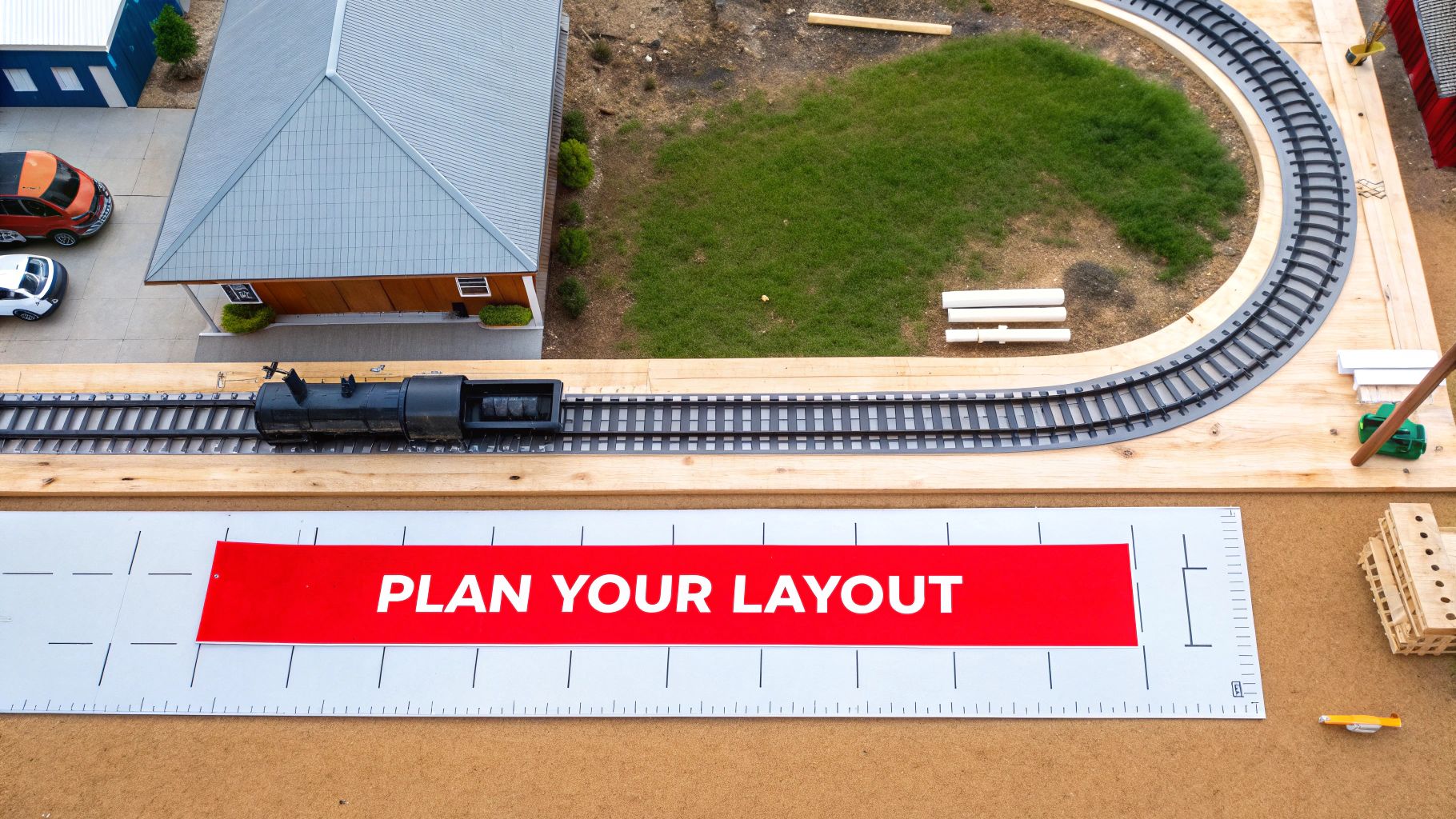
Unlike the smaller scales, you can't just tuck an O scale layout into any old corner. The models are bigger, sure, but the real space-eater is the need for wider curves to keep them running smoothly. This is the single biggest factor to get a handle on when you’re measuring your available room.
Understanding Minimum Curve Radii
In the 3-rail O gauge world, track curves are measured by their diameter. You’ll see track sold with designations like O-31, O-54, or O-72. That number is simply the diameter of a full circle of that track, measured in inches. So, a complete circle of O-31 track measures 31 inches across. Easy enough.
This measurement is your first reality check. A simple loop of O-31 track needs a tabletop that’s at least 32 inches wide just to have a little breathing room on each side. A more generous O-72 curve? That’s going to require a table that’s nearly six and a half feet wide.
The curve you choose directly controls which locomotives you can run. A small 0-6-0 switcher might be perfectly happy chugging around O-31 curves, but a big, highly detailed 4-8-4 steam locomotive will likely derail or bind up on anything tighter than O-72. Always, always check the manufacturer's minimum curve recommendation before buying an engine.
Measuring Your Space for Success
Time to grab a tape measure and get real about your dedicated area. Whether it’s a spare room, a slice of the basement, or a shelf running along a wall, knowing your exact dimensions is step one. And remember, you need to account for more than just the track itself.
-
Aisles and Access: You need room to walk around your layout and, crucially, reach the middle for scenery work or to rescue a derailed car. A good rule of thumb is to keep your layout’s depth to no more than 30 inches from the edge if you can only get to it from one side.
-
Vertical Clearance: Think in three dimensions. Do you have enough height for bridges, tunnels, and cool elevated scenery? O scale locomotives are tall, so you'll want at least 6-7 inches of clearance from the top of the railhead to the bottom of any overpass or tunnel portal.
-
Benchwork and Scenery: Your layout base, or "benchwork," will naturally be a bit larger than your track plan. Scenery like hills and mountains will stick out even further, so build that extra buffer space into your plans from the get-go.
A Quick Planning Checklist
Before you buy a single piece of track, run through these simple questions. Answering them now will save you from a world of frustration later.
- What’s my absolute maximum length and width? Measure the room and decide on the final footprint.
- What’s the biggest locomotive I realistically want to run? Go look up its minimum curve requirement right now.
- Will my chosen curve fit within my maximum dimensions? For instance, an O-54 curve requires a 5-foot wide table, period.
- Can I still reach the center of the layout? Plan for access hatches or a narrower "around-the-walls" design if you can't.
- Is there enough vertical space for tunnels and scenery?
By thinking through these factors, you can design a layout that not only fits your space but also perfectly accommodates the impressive o scale locomotives that pulled you into this amazing hobby in the first place.
Common Questions About O Scale Locomotives
Even if you’ve been in the hobby for years, questions always pop up. When you're just getting your feet wet with O scale locomotives, a few common ones seem to come up again and again. Getting these sorted out early can save you a ton of time, money, and headaches down the road.
One of the first things people ask is about mixing different brands. Can you run a Lionel engine on MTH track, or vice versa? For straightforward, conventional operation with a basic transformer, the answer is almost always yes. Both brands are built for 3-rail O gauge track and usually play nice together, as long as your power pack can handle the load.
But things get tricky when you start diving into command control systems. Lionel's TMCC/Legacy and MTH's DCS are two different digital languages. Trying to run them on the same layout at the same time without the right gear is like trying to have a conversation where one person only speaks French and the other only speaks Japanese—it just creates signal confusion. You'll need some specialized (and often pricey) bridging equipment to get them to cooperate.
Scale versus Gauge Clarified
Another classic point of confusion is the difference between "O Scale" and "O Gauge." People use them interchangeably all the time, but they mean two very different things.
"O Scale" is all about the model's proportion. It’s a strict 1:48 ratio, meaning every inch on the model equals 48 inches on the real thing. "O Gauge", on the other hand, just describes the width of the track—the 1.25 inches between the two outer rails.
This distinction is a big deal. A lot of the classic "toy" style trains are O gauge (they run on the track) but aren't true O scale models. Manufacturers would often shorten or squish the proportions a bit so the trains could handle the super-tight curves on starter set layouts. A true scale model, however, is all about perfect proportions and will demand much broader, more realistic curves.
Upgrading Your Fleet
Sooner or later, you'll want to add some new features to your favorite engines. A big one is adding sound to a silent locomotive. This means installing a sound decoder and a speaker inside the shell. For newer, DCC-ready engines, this can be a simple plug-and-play job. Older DC engines? That's a different story, often requiring some serious wiring work and a bit more know-how.
As you plan out your dream railroad, you might get some great ideas from guides on building miniature city model kits, which are a perfect way to bring your layout to life. Getting a handle on these common topics will give you the confidence you need to grow your collection and start tackling more exciting projects.
At Fusion Scale Hobbies, we carry everything you need to build, maintain, and upgrade your O scale locomotive fleet, from track and scenery to advanced DCC sound decoders. Shop our full collection today!