

The best N scale locomotive is the one that fits your layout—its era, your operational goals, and, of course, your budget. For raw out-of-the-box performance, it's hard to beat Kato, but Atlas nails the prototypical accuracy for modelers who crave realism. For those just getting started, Bachmann offers an incredible value and a great entry point into the hobby.
Choosing Your Perfect N Scale Locomotive
There's a special thrill in N scale railroading—building entire worlds in a space most other scales can't touch. At the center of it all is the locomotive. It's the star of the show, the prime mover that breathes life into your miniature empire.
But with hundreds of models out there, how do you pick the right one? The truth is, there’s no single "best" engine. The perfect choice is a mix of factors that are unique to you and your vision.
Think of this guide as your roadmap. We'll break down the differences between steam, diesel, and electric locomotives, get into the nitty-gritty of the tech that makes them run, and look at the top brands on the market. By the end, you'll know exactly what to look for in an engine you'll be proud to run for years. If you want to see how N scale stacks up against other sizes, our guide on scale model trains offers some great perspective.
Finding Your Starting Point
The journey to the perfect locomotive starts with three simple questions about what you want to achieve. This decision tree is a great way to visualize how your choices narrow down the options, beginning with the most important one: the era you want to model.

This visual guide shows how your preferences for a historical era, operational style (like heavy freight versus passenger service), and budget intersect to narrow down your options effectively.
At a 1:160 ratio, N scale is wildly popular because it lets you build an impressive layout without needing a massive room. This compact size is a huge draw; N scale models make up 20-30% of all model train sales in North America and Europe. The love for N scale is even stronger in Japan, where nearly 40% of hobbyists choose it.
The core decision is about creating a cohesive theme. A modern diesel engine might look out of place in a 1940s steam-era town. Choosing your era first ensures every subsequent decision, from locomotives to buildings and scenery, builds a believable world.
To help you keep track of the key technical details, here’s a quick-reference table. It breaks down the most important features and what they mean for your layout.
Quick Guide to N Scale Locomotive Features
| Feature | What It Affects | Best For |
|---|---|---|
| Motor Type | Smoothness, slow-speed control, noise | Coreless motors offer the best performance, while 3-pole motors are common in budget models. |
| Drivetrain | Reliability, pulling power, maintenance | All-wheel drive is standard for good reason. Look for models with a proven, quiet gear train. |
| DCC/Sound | Control flexibility, operational realism | DCC-ready gives you an upgrade path. DCC with sound is for those who want total immersion. |
| Couplers | Reliable train operation, switching ease | Body-mounted knuckle couplers are the gold standard for realistic and trouble-free operation. |
| Scale Fidelity | Visual realism, historical accuracy | Modelers who want their layout to be a faithful replica of a specific time and place. |
This table is a great starting point, but let’s dig into each of these features to understand what really makes a locomotive tick.
Understanding Locomotive Types and Their Roles
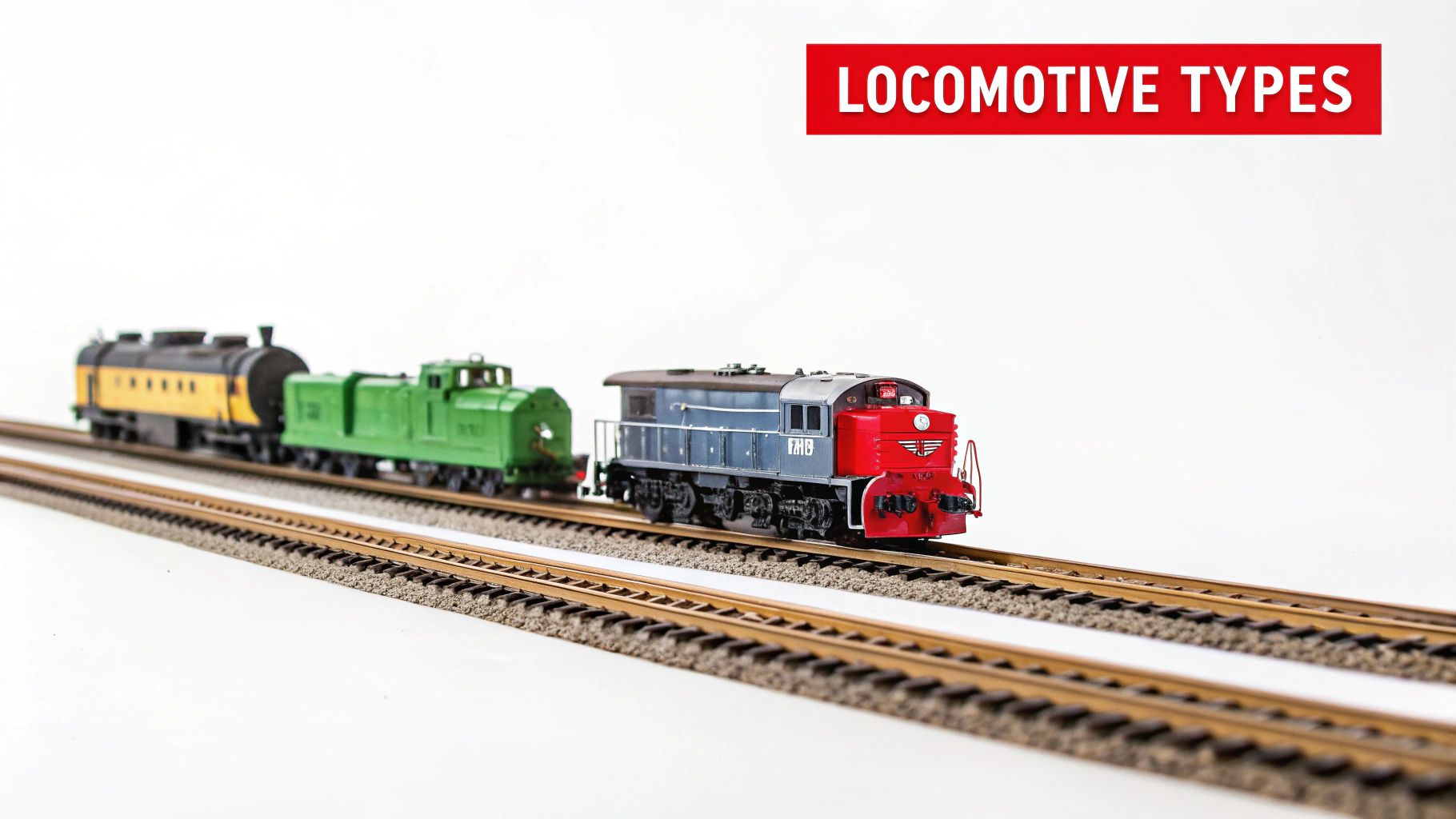
Every locomotive tells a story. Each one was built for a specific job, and choosing a type isn't just about what looks cool—it’s about defining the entire character and operational era of your railroad. Think of it like casting the lead actor in a movie. Their personality sets the tone for everything else.
The three main characters in the world of railroading are steam, diesel, and electric locomotives. Each represents a distinct period of technological innovation and has a unique presence, both visually and operationally. Picking the right one is your first major step in finding the best N scale locomotives to bring your layout to life.
The Age of Steam Locomotives
Steam locomotives are the titans of a bygone era. They instantly evoke images of the Wild West, the Roaring Twenties, or the industrial might of World War II. These engines are mechanical marvels of pistons, rods, and raw power, making them a captivating centerpiece for any historical layout.
A classic steam engine is like a vintage muscle car. It’s loud, complex, and has an undeniable charm that modern machines often lack. For us modelers, this means a visual feast of moving parts and intricate details that look fantastic, especially at slow speeds where you can really appreciate the motion.
But their specialized designs mean you need to match them carefully to their intended job:
- Yard Switchers: Small engines, like the classic 0-6-0, are built for the low-speed work of arranging cars in a rail yard.
- Heavy Freight: Massive articulated locomotives like the Big Boy were born to haul immense loads over steep mountain passes.
- Fast Passenger: Sleek, streamlined designs like the PRR K4 Pacific were the high-speed champions of their day, pulling iconic passenger trains.
The Diesel Revolution
Starting in the 1940s and completely taking over by the 1960s, diesel-electric locomotives changed railroading forever. They offered greater efficiency, required far less maintenance, and gave railroads an operational flexibility that steam just couldn't match.
A diesel locomotive is the versatile work truck of the railroad world. A single model, like a GP9 or an SD40-2, could be found doing everything from switching a few cars in a small town to pulling a mile-long freight train across the country. This versatility makes them an excellent choice for modelers who want to run a wide variety of operations without needing a huge roster of specialized engines.
Diesel locomotives provide the broadest modeling flexibility. Whether you’re modeling a layout set in 1955 or the present day, there's a diesel that fits perfectly. Their long service lives mean many prototypes ran for decades, often being sold and repainted for different railroads.
The Electric Specialists
Electric locomotives are the sleek, quiet specialists of the railway. Powered by overhead catenary wires or a third rail, they are incredibly powerful and efficient, making them ideal for specific, high-demand roles. You’ll often find them on high-speed passenger corridors or hauling heavy coal and ore trains through mountains where their power is a huge advantage.
Choosing an electric locomotive means committing to modeling the necessary infrastructure, like catenary poles and wires, which adds a fascinating layer of detail to your layout. They represent a unique and visually striking form of railroading, perfect for modelers looking to replicate specific mainlines like the famous Northeast Corridor in the United States. To dive deeper into these categories, check out our guide on the different types of model trains.
The Technology Driving Your N Scale Locomotive
To really get what separates a good locomotive from a great one, we need to pop the hood and look inside. The tiny technology packed under the shell is what dictates performance, realism, and, ultimately, how much fun you have running your trains.
It's like the difference between a basic family car and a high-performance sports car. Both will get you down the road, but how they do it is a world of difference.
Two key things define a locomotive’s technical chops: the quality of its motor and drivetrain, and the smarts of its control system. Get a handle on these, and you'll be able to read a spec sheet and know exactly what you’re getting.
The Heart of the Engine: The Motor and Drive
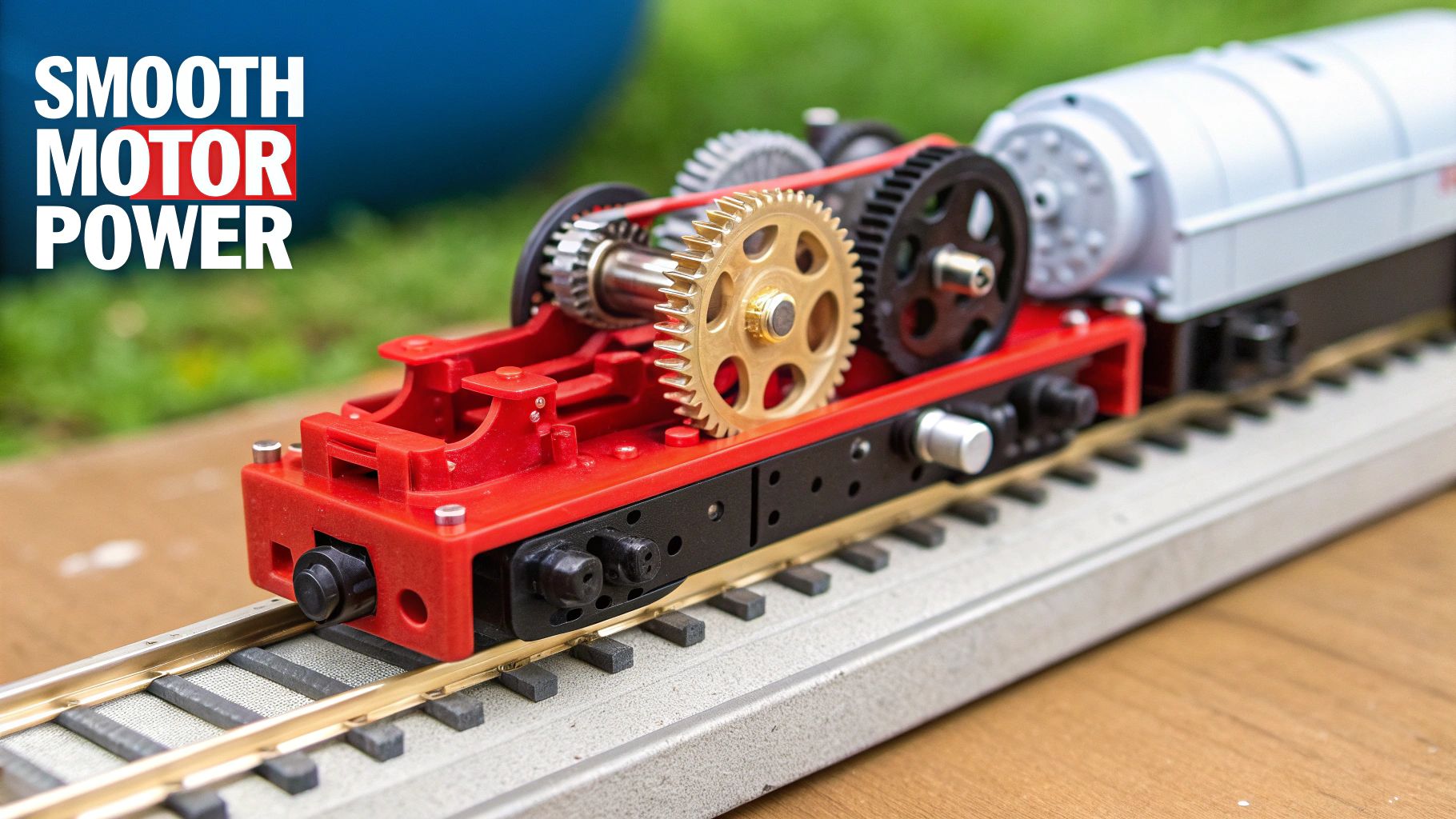
The motor is the heart of your locomotive, turning electricity from the track into motion. The terminology can sound a bit technical, but the ideas are pretty simple. You'll often find that older or more budget-friendly models use a basic 3-pole motor. It gets the job done, but it can be noisy and a little jerky at low speeds.
For truly top-tier performance, you want to look for models with a 5-pole skew-wound motor. Think of this as the finely tuned engine in a luxury car. The extra "poles" (which are basically electromagnets) and their angled "skew" create a much smoother rotation.
This translates directly into quieter operation and fantastic slow-speed control—perfect for tricky switching moves in a yard or a gentle, realistic start from a station.
Key Takeaway: A 5-pole skew-wound motor is the gold standard for smooth, quiet, and reliable performance. It's a feature that makes a real, tangible difference in how your locomotive runs on the track.
The motor’s power gets to the wheels through the drivetrain. Thankfully, modern N scale locomotives almost always feature all-wheel drive and pickup, which means consistent electrical contact and great pulling power. You can really see the quality engineering from brands like Kato in their whisper-quiet, precisely meshed gears that deliver flawless performance right out of the box.
The Brains of the Operation: DC vs DCC Control
The single biggest tech decision you'll face is choosing how to control your trains. This boils down to two systems: the old-school Direct Current (DC) and the modern Digital Command Control (DCC).
-
Direct Current (DC) Control: This is the classic, time-tested way to run model trains. You send power through the rails, and you control the locomotive's speed and direction by adjusting the voltage. It’s simple and totally reliable, but it has one huge limitation: every locomotive on the same piece of track does the exact same thing. It’s like having one light switch that controls every single bulb in the room.
-
Digital Command Control (DCC): DCC completely changes the game. Instead of varying the voltage, the track gets constant power all the time. Each locomotive has a tiny computer chip inside called a decoder. This decoder listens for digital commands sent from your controller, allowing you to operate each engine independently—even when they're on the very same track.
This means you can have a passenger train flying down the mainline at speed while another engine is slowly shunting cars in a nearby yard. All at the same time, with one controller. It opens up a whole new world of operational flexibility. To learn more about how it all works, check out our complete guide to Digital Command Control for model trains.
DC vs DCC N Scale Locomotives
Choosing between DC and DCC really depends on your goals for your layout. This table breaks down the core differences to help you decide which system is the right fit for you.
| Feature | DC (Direct Current) | DCC (Digital Command Control) |
|---|---|---|
| Control | Controls the track, not the individual train. | Controls each locomotive independently. |
| Wiring | Can get complicated with multiple power blocks. | Simpler track wiring, even for complex layouts. |
| Realism | Basic speed and direction control. | Independent control, plus lights and sound effects. |
| Cost | Lower initial cost for power packs and locos. | Higher cost for decoders and DCC systems. |
| Best For | Beginners, simple loops, or budget-focused setups. | Modelers who want realism and complex operations. |
Ultimately, understanding the tech behind each system will help you pick a locomotive that will grow with you in the hobby, whether you stick with the simplicity of DC or embrace the power of DCC.
The Immersive World of DCC and Sound
DCC unlocks a level of realism that was once just a dream in N scale. Beyond just controlling the movement, decoders can manage a locomotive’s lights and—most excitingly—its sound. The best N scale locomotives today often come with factory-installed sound systems that truly bring the model to life.
These technological leaps have completely transformed what we expect from our models. The adoption rate of DCC technology now tops 70% in premium models, making it a common feature. Sound decoders with detailed engine rumbles, horn blasts, and squealing brakes have become almost standard in high-end N scale engines.
Beyond the physical models, the world of railroading is also evolving digitally. For anyone interested in the future, you can even learn how to create 3D train models with AI, opening up amazing possibilities for custom designs and virtual layouts.
Navigating the Top N Scale Locomotive Brands
Picking a brand is a lot more than just choosing a name on a box. It’s about finding a company whose engineering philosophy, attention to detail, and performance standards line up with what you want out of the hobby.
Think of it like the car industry. Some manufacturers build ultra-reliable engines that just run forever. Others focus on high-performance machines that look incredible. And some offer affordable, practical options that are perfect for getting started. There’s no single "best" brand—but there is absolutely a brand that’s the best for you.
Let's break down the major players in the N scale world. We'll look at what makes each one tick, so you can pick a locomotive from a company whose priorities match your own, whether that’s flawless operation, dead-on historical accuracy, or just great value.
Kato: The Gold Standard of Performance
Kato, a Japanese manufacturer, has earned a legendary reputation for its bulletproof engineering and incredible quality control. Hobbyists know that when you buy a Kato, it's going to run perfectly right out of the box. Their mechanisms are famous for being whisper-quiet and buttery-smooth.
For a lot of seasoned modelers, Kato is the benchmark. All other N scale locomotives are measured against it.
How do they do it? Kato designs and builds nearly everything in-house, from their powerful motors to the intricate details on the shell. This gives them a level of consistency and reliability that’s tough to beat. If your number one priority is flawless, trouble-free operation for decades to come, Kato is almost always the answer.
Kato is all about operational excellence. When you buy one of their locomotives, you expect it to perform perfectly from day one—and it does. This makes them a fantastic choice for beginners who want a frustration-free start and for experts who demand nothing less than peak performance.
Bachmann: The Accessible Entry Point
Bachmann is one of the most recognized names in the hobby for a good reason. They offer a fantastic mix of affordability and solid features, making them the perfect starting point for newcomers or anyone looking to build a big fleet without emptying their wallet.
While they might not always have the super-fine details of the more premium brands, their modern locomotives offer surprisingly good performance for the price.
Over the years, Bachmann has seriously upped their game. Their "Spectrum" series, for instance, represents a much higher standard of detail and mechanics, often giving more expensive models a run for their money. This makes them a really versatile brand that serves a wide range of modelers.
Atlas: The Champion of Prototypical Accuracy
If you're the kind of modeler who obsesses over historical and physical accuracy, Atlas is your brand. This American company is famous for its dedication to creating models that are faithful replicas of specific North American railroad prototypes. They go deep into researching paint schemes, lettering, and railroad-specific details.
Are you modeling a particular railroad during a specific era? There’s a good chance Atlas makes the exact locomotive you need. They even offer multiple "road numbers" for many of their releases, so you can build a realistic roster of engines just like the real railroads did. On top of that, their locomotives are known for being reliable runners, making them a favorite for operators who value both looks and performance.
ScaleTrains and InterMountain: The Detail Specialists
In the world of high-fidelity modeling, two brands are constantly pushing the limits of detail and realism: ScaleTrains and InterMountain Railway Company.
- ScaleTrains: A newer player on the scene, ScaleTrains quickly built a reputation for museum-quality models. They smartly offer different tiers, from their operator-focused "Operator" line to the incredibly detailed "Rivet Counter" line, letting you pick the level of detail that fits your budget.
- InterMountain: Best known for their beautifully detailed freight cars, InterMountain also produces some seriously high-quality locomotives. They're especially respected for their fine details and accurate paint jobs, making them another top choice for discerning modelers.
Choosing between these two often comes down to who makes the specific prototype locomotive you’re after. Either way, both brands represent the absolute peak of detail available in ready-to-run N scale.
Matching Your Budget with the Right Features
Getting into N scale locomotives is a thrill, but let's be honest—it’s easy to get lost in a sea of price tags. How much should you really spend? What’s the actual difference between a $100 engine and a $300 one?
Figuring out the market's price tiers is the key to investing wisely. Think of it like buying a car. You've got your reliable entry-level sedans, feature-packed mid-range SUVs, and high-performance luxury models. Each has its place and delivers an experience that matches its price. The N scale world works the exact same way.
Let’s break down the three main budget tiers so you know exactly what to expect at each level. This will help you pick a locomotive that fits your goals without blowing your budget.
Entry-Level Locomotives: Under $150
This is the perfect gateway into the hobby. If you're buying your first engine or looking to build a massive freight consist without breaking the bank, this is your zone. These locomotives are the workhorses of the N scale world—built to be reliable, durable, and affordable.
You won't find the finest, most delicate details here, but the quality of modern entry-level models from brands like Bachmann or the Atlas "Trainman" series is surprisingly good. You can expect a solid motor (often a 3-pole design), decent pulling power, and a nicely decorated shell. These engines are made to run well and handle the bumps and bruises of a layout that sees a lot of action.
What to Expect: A dependable runner with good basic detail and a durable build. These models are usually DC-only, but they offer a fantastic, frustration-free start or an economical way to expand your roster.
Mid-Range Locomotives: $150 to $250
Stepping up into the mid-range is where you start to see some serious upgrades in both performance and detail. For many hobbyists, this tier is the sweet spot, offering a fantastic balance of high-end features and reasonable cost. Here, you’ll find killer models from top brands like Kato and the Atlas master line.
The biggest difference is under the shell. These locomotives almost always have a superior 5-pole skew-wound motor, which translates to whisper-quiet operation and incredibly smooth slow-speed control. You’ll also notice finer details like separately applied grab irons, see-through grills, and more accurate paint schemes.
Many engines in this price range are "DCC-Ready," meaning they come with a factory-installed circuit board ready for a decoder. This makes upgrading to Digital Command Control a simple plug-and-play process, giving you a clear path to more advanced operations down the road.
Premium Locomotives: Over $250
Welcome to the top tier. This is where manufacturers pull out all the stops to create a truly immersive and authentic experience. Premium locomotives are for the hobbyist who wants the ultimate in realism, performance, and features, right out of the box. Brands like ScaleTrains' "Rivet Counter" series and sound-equipped models from Kato, Broadway Limited, and Atlas absolutely own this space.
What sets these incredible models apart?
- Factory-Installed DCC and Sound: These locomotives come ready to run with high-quality DCC sound decoders, bringing your layout to life with realistic engine rumbles, horn blasts, and bell sounds.
- Museum-Quality Detail: Every detail is meticulously rendered. We're talking razor-sharp lettering, intricate piping, and prototype-specific features that will blow you away.
- Flawless Performance: They combine the best motors and mechanisms with precision engineering for perfect, silky-smooth operation.
When you invest in a premium model, you're getting a locomotive that performs as beautifully as it looks. It delivers a sensory experience that is the pinnacle of ready-to-run N scale technology and a worthy centerpiece for any layout.
Essential Maintenance for Peak Performance
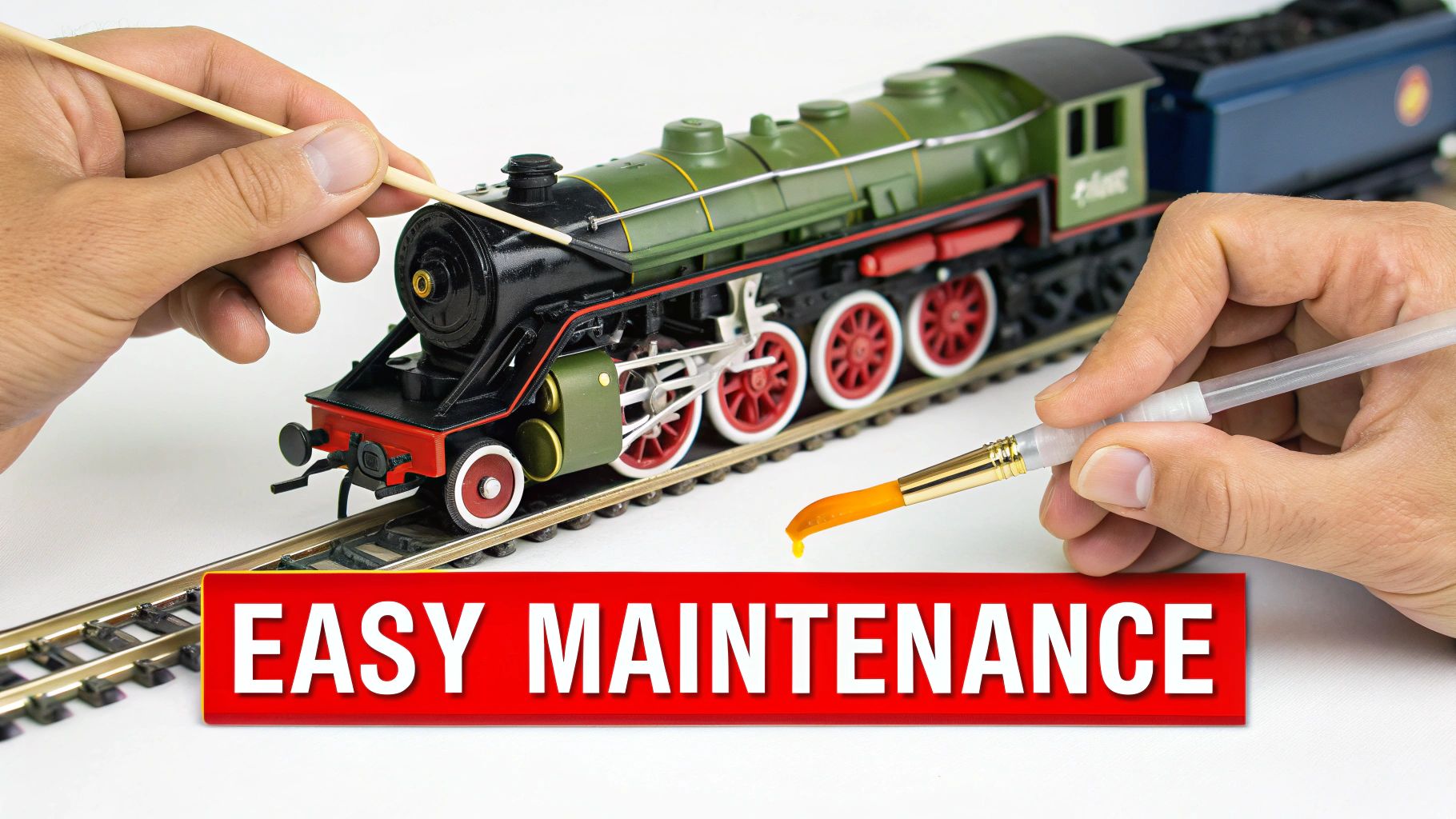 A high-quality N scale locomotive is a precision machine. Just like any fine instrument, it needs a little preventative care to perform at its best. Don't think of maintenance as a chore. See it as a rewarding part of the hobby that deepens your connection with your models and guarantees smooth, reliable operation every time you hit the tracks.
Protecting your investment is simpler than you might think. A few basic routines can head off the most common operational headaches, keeping your best N scale locomotives running like new for decades. It really boils down to two critical tasks: keeping things clean and properly lubricated.
The Basics of Cleaning and Lubrication
Consistent electrical contact is everything in model railroading. Over time, microscopic dirt and oil build up on both the track and the locomotive’s wheels, causing those dreaded flickering lights, stuttering movement, and poor overall performance.
Cleaning your locomotive’s wheels is your first line of defense. You can do this by gently rubbing the wheel treads with a cotton swab dipped in isopropyl alcohol or a specialized track cleaner. For more stubborn grime, a fine abrasive track cleaning block can be used, but always with a light touch—you don't want to scratch the metal.
When it comes to lubrication, "less is more" is the golden rule. A tiny, pinpoint drop of conductive oil on the motor bearings and a plastic-safe grease on the gears is all you need. Over-oiling is a common mistake that just attracts dirt and can even damage sensitive electronics.
A simple maintenance schedule can make a huge difference:
- Quick Clean: Wipe down your track rails before each operating session.
- Wheel Check: Clean your locomotive wheels every 10-15 hours of runtime, or whenever you notice performance issues.
- Lubrication: Re-lube gears and motor bearings sparingly every 50 hours of operation or annually, whichever comes first.
Simple Tuning for Smooth Operations
Beyond cleaning, a couple of quick checks can solve many common problems, especially with couplers. These small adjustments are key to ensuring your entire train runs together seamlessly.
First, check the coupler height. Use an NMRA standards gauge to ensure your locomotive and rolling stock couplers are all at the same height. Mismatched heights are a primary cause of frustrating derailments, especially when you're backing up a long train.
Next, verify the wheel gauge. An NMRA gauge can also check if the wheels on your locomotive are the correct distance apart. Wheels that are too narrow or too wide can struggle to navigate turnouts and curves, leading to stalls or derailments. These simple checks are what transform good engines into great ones.
Common Questions About N Scale Locomotives
Even with the best guide, a few questions always come up right before you pull the trigger on a new locomotive. Let's tackle the most common ones we hear from fellow modelers to help you make that final decision with confidence.
Are N Scale Locomotives From Different Brands Compatible?
Yes, for the most part. Locomotives from all the major players like Kato, Atlas, and Bachmann are all built to run on standard N scale track. You won't have any issues there.
The one spot you'll want to pay a little attention to is the couplers. While most brands have settled on a standard knuckle coupler, you can sometimes run into tiny height differences between manufacturers. This might require a small, simple adjustment to get perfectly smooth coupling between your new engine and existing rolling stock.
Key Takeaway: Don't hesitate to mix and match locomotive brands on your layout. Focus on the engine you love—any minor coupler tuning is a quick fix most hobbyists can handle in minutes.
What Does "DCC Ready" Mean?
Think of a “DCC Ready” locomotive as being prepped for the future. Right out of the box, it's designed to run on a traditional DC (analog) power pack.
But the key is what's inside. It has a special plug-and-play socket or a pre-wired harness waiting for a DCC decoder. This makes converting it to Digital Command Control incredibly simple, usually without needing to break out the soldering iron.
Do I Really Need a Locomotive With Sound?
Honestly, this is all about personal preference and what makes the hobby fun for you. Sound adds a fantastic layer of realism that can completely change the feel of your layout. There's nothing quite like hearing the authentic chug of a steam engine or the blast of a diesel horn.
That said, sound isn't required for operation. If you're working within a certain budget, a great strategy is to start with a top-notch silent locomotive. You can always add a premium, sound-equipped engine to your roster down the road as your next big upgrade.
Ready to find the heart of your railroad? Explore a huge selection of the best N scale locomotives from top brands at Fusion Scale Hobbies. Find the perfect engine to bring your layout to life today at https://fusionscalehobbies.com.