

Welcome to the incredible world of N scale trains, where you can build a massive, detailed railroad empire without needing a massive amount of space. This scale hits that sweet spot between intricate modeling and manageable size, making it a huge favorite for everyone from total beginners to seasoned pros. It’s all about creating epic scenery and running complex operations, all without taking over your entire basement.
Exploring the World of N Scale Trains
Picture this: a sprawling railroad winding through mountains, crossing dramatic bridges, and serving busy industrial towns, all laid out on a surface no bigger than a dining room table. That's the magic of N scale.
Working at a 1:160 proportion to the real thing, every inch of your model represents more than 13 feet of actual railroad. This compact size is its greatest strength. Where a larger HO scale layout can quickly eat up a spare room, a detailed N scale railroad can thrive on a tabletop or even a narrow shelf. And don't think for a second that "small" means sacrificing detail. Modern manufacturing techniques pack incredibly fine features onto locomotives and rolling stock, creating a truly immersive experience.
The Perfect Balance of Size and Detail
The real beauty of N scale is how well it portrays distance and a sense of true scale. Because the models are smaller, you can fit more of everything into your layout: longer trains, broader curves, and more impressive landscapes. This makes it possible to model mainline operations in a way that feels authentic, something that’s often a huge challenge in larger scales without a ton of room.
The essence of N scale is achieving a grand vision in a modest footprint. You can model a complete scene—a town, a railyard, and the countryside connecting them—in a space where other scales might only fit a single industry.
This scale gives you a unique bird's-eye view, creating the feeling of looking over a vast, living landscape. It pulls the focus away from just a single model and puts it on the overall scene and the railroad's place within it.
Why N Scale Is a Global Favorite
First introduced back in the late 1960s, N scale has since become one of the most popular choices for model railroaders across the globe. Its appeal comes down to that compact size, which lets enthusiasts build out extensive and complex layouts even when space is tight.
Here's a quick look at what makes N scale such a standout choice in the hobby.
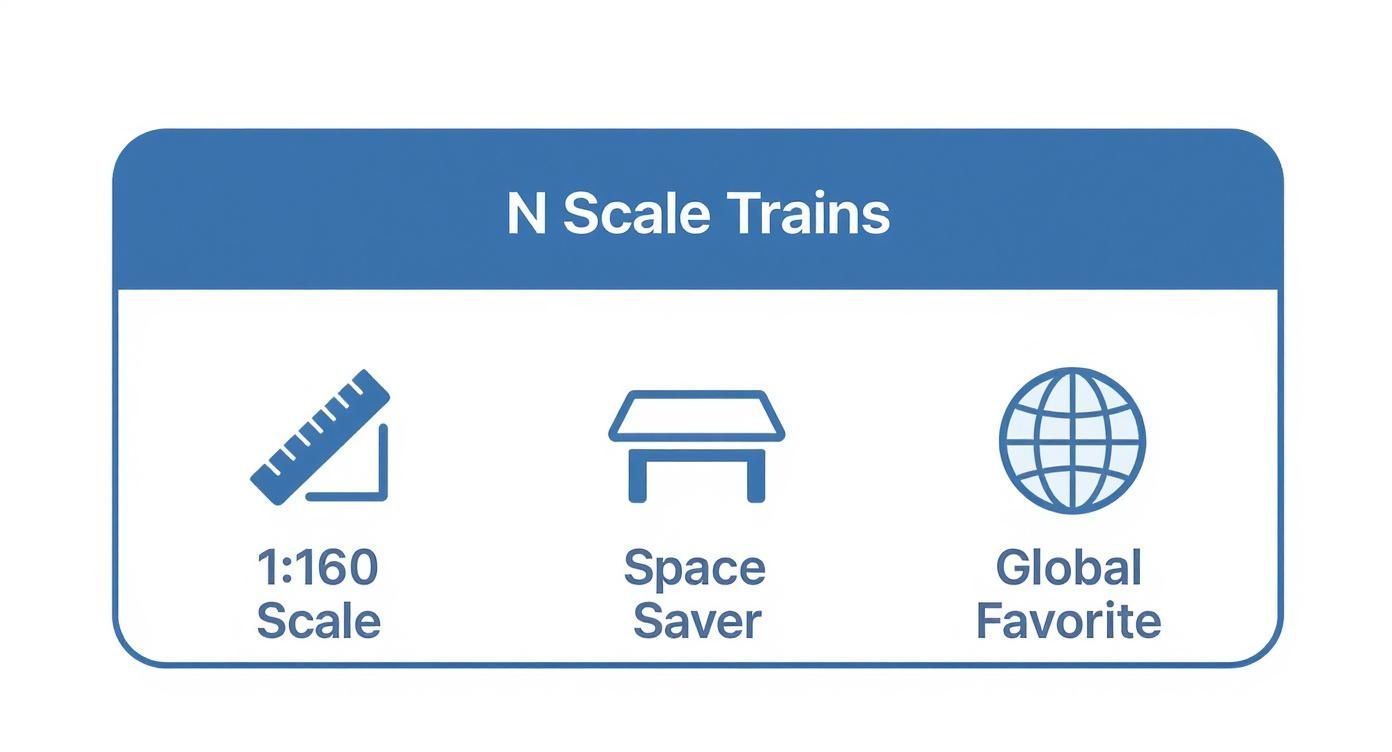
As you can see, that 1:160 scale ratio directly translates into big space savings, making it a go-to standard for impressive yet practical layouts worldwide.
Getting a feel for how different sizes stack up is key, and N scale offers a totally different experience compared to its larger cousins. To help you visualize these differences, here’s a quick comparison of the big three.
N Scale vs HO Scale vs O Scale Comparison
| Feature | N Scale | HO Scale | O Scale |
|---|---|---|---|
| Scale Ratio | 1:160 | 1:87 | 1:48 |
| Track Gauge | 9 mm | 16.5 mm | 1.25 in |
| Typical Space | Tabletop, shelf | Spare room | Basement, garage |
This table shows just how much more layout you can fit into a smaller area with N scale.
To dive deeper and find the perfect fit for your own goals, check out our complete guide where we have all the model railway scales explained. This resource will help you compare N scale directly to other popular options and make the right call for your next project.
Weighing the Pros and Cons of N Scale
Every model railroad scale offers a completely different experience, with its own set of rewards and trade-offs. Picking your scale is probably the single most important decision you’ll make in this hobby. It dictates everything that follows, from the kind of layout you can build to the very feel of the models in your hands. This isn't just about size—it's about finding the perfect match for your available space, your modeling ambitions, and even your eyesight and dexterity.
Committing to N scale trains opens up some truly incredible possibilities, but it also brings its own unique challenges. By taking an honest look at both the massive advantages and the practical realities, you can decide with confidence if this miniature world is the right place for your creative energy. Let's dig into the pros and cons to see if N scale is the right fit for you.
The Advantages of Modeling in N Scale
The number one reason people flock to N scale is its incredible space efficiency. It's a simple fact: because the models are nearly half the size of their HO scale counterparts, you can build a railroad that is far more expansive and operationally interesting in the exact same footprint.
-
Epic Scenery and a Sense of Distance: N scale lets you model sweeping curves, run satisfyingly long trains, and create vast, rolling landscapes that truly sell the illusion of distance. A train winding its way through a mountain pass just feels more believable when the scenery doesn't abruptly end a few feet away.
-
Complex Operations: You can pack in more track, more industries, and more sophisticated yard designs. For anyone who loves the operational side of the hobby, this is huge. It means more fun sorting freight cars, running multiple trains on a busy mainline, or serving a whole district of customers.
-
Excellent Modern Equipment Selection: If you're a fan of modern railroading (think big diesel engines and container trains), N scale is a fantastic place to be. Manufacturers have been on a roll, producing a huge variety of contemporary locomotives, intermodal gear, and specialized freight cars—often releasing them in N scale first.
This core benefit of building "more railroad in less space" is what seals the deal for most. It can turn a spare room, a corner of the garage, or even a narrow shelf along the wall into the canvas for a complete railroad empire.
The real magic of N scale is its ability to model entire railroad subdivisions, not just a single town or industry. It lets you tell a bigger, more compelling story within the space you have.
The Challenges and Realities of N Scale
Of course, the very thing that gives N scale its power—its small size—also introduces some clear challenges. It pays to be realistic about what working in this compact scale really involves. The models are, by their nature, more delicate and can be a source of frustration for anyone with unsteady hands or less-than-perfect eyesight.
Just handling the tiny locomotives and freight cars requires a gentle touch. Getting them on the track, coupling cars together, and doing basic maintenance all call for a bit more precision and patience. This isn't a showstopper for most people, but it’s a day-to-day reality of the scale you have to be comfortable with.
Precision and Finesse Are Key
That need for precision goes way beyond just handling the trains. Pretty much every part of building an N scale layout demands a little extra care to get good, reliable results.
-
Track Work is Critical: A tiny kink or uneven joint in your track that might be a minor bump in a larger scale can cause constant derailments in N scale. Smooth joints, perfectly level track, and consistent curves aren't just nice to have; they are absolutely essential for your trains to run well.
-
Detailing Requires Patience: Working with minuscule detail parts, like grab irons on a boxcar or window glazing for a building, can definitely test your patience. A good pair of fine-tipped tweezers, a magnifier, and a steady hand aren't just tools—they're your best friends in N scale.
-
Electrical Reliability Demands Cleanliness: Because of their smaller wheels and lighter weight, N scale locomotives are much more sensitive to dirt and dust on the rails. Keeping your track and your locomotive wheels spotlessly clean isn't just a suggestion; it's a non-negotiable part of keeping things running smoothly.
In the end, choosing N scale is all about embracing this trade-off. You gain enormous scenic and operational potential, but in return, you have to work with smaller, more delicate components that demand a higher level of care. For countless modelers, it's a bargain they are more than happy to make.
Designing Your First N Scale Layout
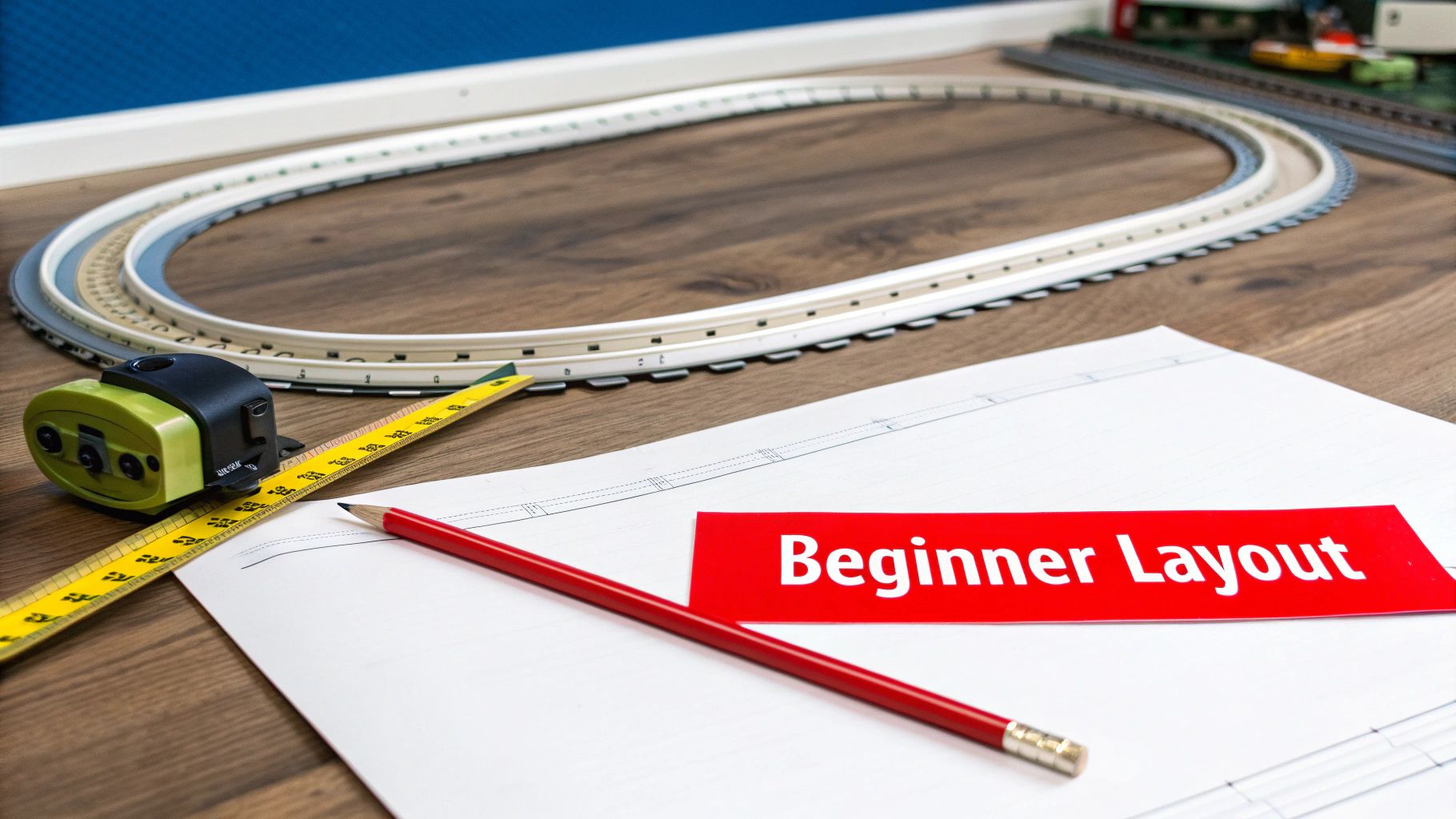
Alright, let's get down to the fun part: moving from ideas to actually planning your railroad. Think of this section as your hands-on guide to designing an N scale layout that fits your space and your vision. The very first step is simple but absolutely critical: grab a tape measure and get the exact dimensions of your space. Knowing precisely how much room you’re working with—whether it's a classic 4x8-foot sheet of plywood or a narrow 12-inch deep shelf—is the foundation of every successful layout.
Once you have your numbers, the next big concept to wrap your head around is minimum radius. In simple terms, this is the tightest turn your trains can handle without derailing or looking toy-like. For N scale, a wider, gentler curve always looks more realistic and runs better, especially with longer locomotives and cars. But for a compact layout, a good starting point is an 11-inch radius. This one measurement will have a huge impact on what kind of track plan you can build.
Classic Starter Layout Designs
Getting started doesn’t mean you need a sprawling, complicated design. In fact, some of the most satisfying layouts are simple in concept but offer hours of engaging operation. The hobby's sustained appeal is no secret; the global model train market, which covers all scales, was valued at around USD 1.2 billion in 2023 and is only expected to grow. You can get more insights on this trend and see the market's future projections.
To get your own ideas rolling, let's look at three classic, beginner-friendly designs. These prove you don't need a massive footprint to have a great time in N scale.
1. The Simple Oval with a Passing Siding
This is the quintessential starter layout, and for good reason. It’s easy to build and gives you that immediate satisfaction of running a train.
- Footprint: It fits perfectly on a 2.5 x 4-foot board or even a standard hollow-core door from the hardware store.
- Operation: At its most basic, you get a continuous loop where you can just sit back and watch your train run. But the magic happens when you add a "passing siding"—a second track alongside the main oval. This simple addition dramatically boosts the fun, letting you park one train while another goes by or simulate two trains meeting on a single line.
2. The Compact Switching Puzzle
If you enjoy the operational challenge of railroading more than just watching trains go in circles, a switching layout is a fantastic choice. This design is all about sorting freight cars and delivering them to different industries.
- Footprint: You can build one of these on a very narrow shelf, sometimes as small as 1 x 6 feet.
- Operation: The goal here isn't endless running; it's about solving a puzzle. You’re given a "switch list" of cars to arrange and deliver to specific spots at various industries. It’s a thoughtful and immersive way to operate your trains that packs a ton of fun into a tiny space. You'll often hear these called an "Inglenook" or "Timesaver" layout.
3. The Point-to-Point Shelf Layout
This design simulates a small segment of a much larger railroad, running from one point (like a yard) to another (like a town). It ditches the continuous loop in favor of more realistic, destination-based operation.
- Footprint: Perfect for long, narrow spaces. A 1 x 8-foot or 1.5 x 10-foot shelf is a popular choice.
- Operation: The journey itself becomes the focus. You might run a train from a small staging area at one end to a town with a few industries at the other, perform your switching duties, and then make the return trip. It feels more purposeful and is an excellent way to model a specific railroad's branch line.
No matter which design speaks to you, the key is to start small and keep it manageable. A simple, finished layout that runs reliably is infinitely more rewarding than a massive, unfinished project that just gathers dust and causes frustration.
Putting Your Plan on Paper
Before you buy a single piece of track, sketch out your idea. You can go old-school with graph paper (letting each square represent a few inches) or use one of the many free online track planning software tools available. This step is crucial—it helps you visualize the final layout, confirm your curves and sidings will actually fit, and make sure you leave enough room for buildings and scenery. Trust me, planning is a genuinely enjoyable part of the process, and a good plan is your roadmap to building the N scale layout you’ve been dreaming of.
Understanding DC and DCC Power Systems
Powering your N scale trains is the moment your miniature world sparks to life. It's where static models become a living, breathing railroad. When it comes to controlling your trains, you have two main paths: the traditional Direct Current (DC) system or the more modern Digital Command Control (DCC). Picking the right one for you will shape your entire experience in the hobby.
Think of DC control like a simple dimmer switch in a room full of lights. You turn the knob on your power pack, sending more voltage down the entire track, and every engine on that track speeds up. Turn it down, and they all slow down together. It’s a beautifully simple and reliable system that’s been the backbone of the hobby for decades.
DCC, on the other hand, is like giving your layout a smart home system. A constant, full-power electrical signal is always present on the track, but it's also carrying digital messages. Each locomotive has a tiny computer chip—a decoder—that listens for its own unique address. This lets you control each train’s speed, direction, and special features all on its own, even when they're sitting on the very same piece of track.
The Simplicity of Direct Current (DC)
DC is the classic, tried-and-true method for running model trains. It’s what you’ll find in most beginner train sets, and for good reason. Its biggest draw is its straightforward nature and lower cost to get started. A basic DC setup is just a power pack plugged into the wall with two wires running to the track.
- How it Works: The throttle knob on the power pack varies the track voltage, usually from 0 to about 12 volts. More juice equals more speed. Simple as that.
- Controlling Multiple Trains: If you want to run more than one train independently, you have to get creative. This involves wiring your layout into electrically separate sections, called "blocks," with each block needing its own power controller. This can lead to some complex wiring and a whole panel of switches.
- Best For: Simple, small layouts like a basic oval of track, or for modelers on a budget who appreciate the classic, hands-on feel of old-school model railroading.
This direct approach gets you up and running fast and is a fantastic way to learn the fundamentals of model railroad electricity.
The Power and Flexibility of DCC
Digital Command Control has been a genuine game-changer, especially for N scale trains. Since you can pack so much more operational action into a smaller N scale space, being able to control each train individually becomes incredibly powerful. With DCC, your operational possibilities just explode.
DCC fundamentally shifts control from the track to the locomotive itself. You're no longer just "powering a section of track"; you are "talking to a specific train," giving you a level of freedom and realism that was once impossible.
This leap in technology is a huge reason the hobby continues to grow. The model train industry is projected to see a sustained compound annual growth rate (CAGR) of around 6% between 2024 and 2033, and much of that is fueled by innovations like DCC that bring new and returning modelers into the fold. You can check out more details about the model train market's promising future if you're curious.
Advanced Features Unleashed by DCC
The real magic of DCC isn't just about controlling multiple trains. That decoder inside each locomotive can also manage a whole suite of realistic features, turning your models into true miniature machines.
Key DCC Features:
- Realistic Sound: DCC decoders can store and play high-quality sound files recorded from real locomotives. We're talking engine startup sequences, the rumble of a diesel motor, authentic horn and bell sounds, and the squeal of brakes.
- Advanced Lighting: You get total control over headlights, ditch lights, cab lights, and strobes—all independently. You can even program special effects like flashing warning lights.
- Smoother Performance: DCC offers far better slow-speed control, letting your trains crawl through yards and stations with incredible realism, without the stuttering or stalling common in DC.
While the initial investment in a DCC starter system and decoders is higher, the payoff in operational fun and realism is massive. To get a deeper look at how it all works, check out our in-depth guide to Digital Command Control for model trains. Ultimately, the choice between DC and DCC comes down to your budget and what you dream of doing with your N scale layout.
Bringing Your Miniature World to Life with Scenery
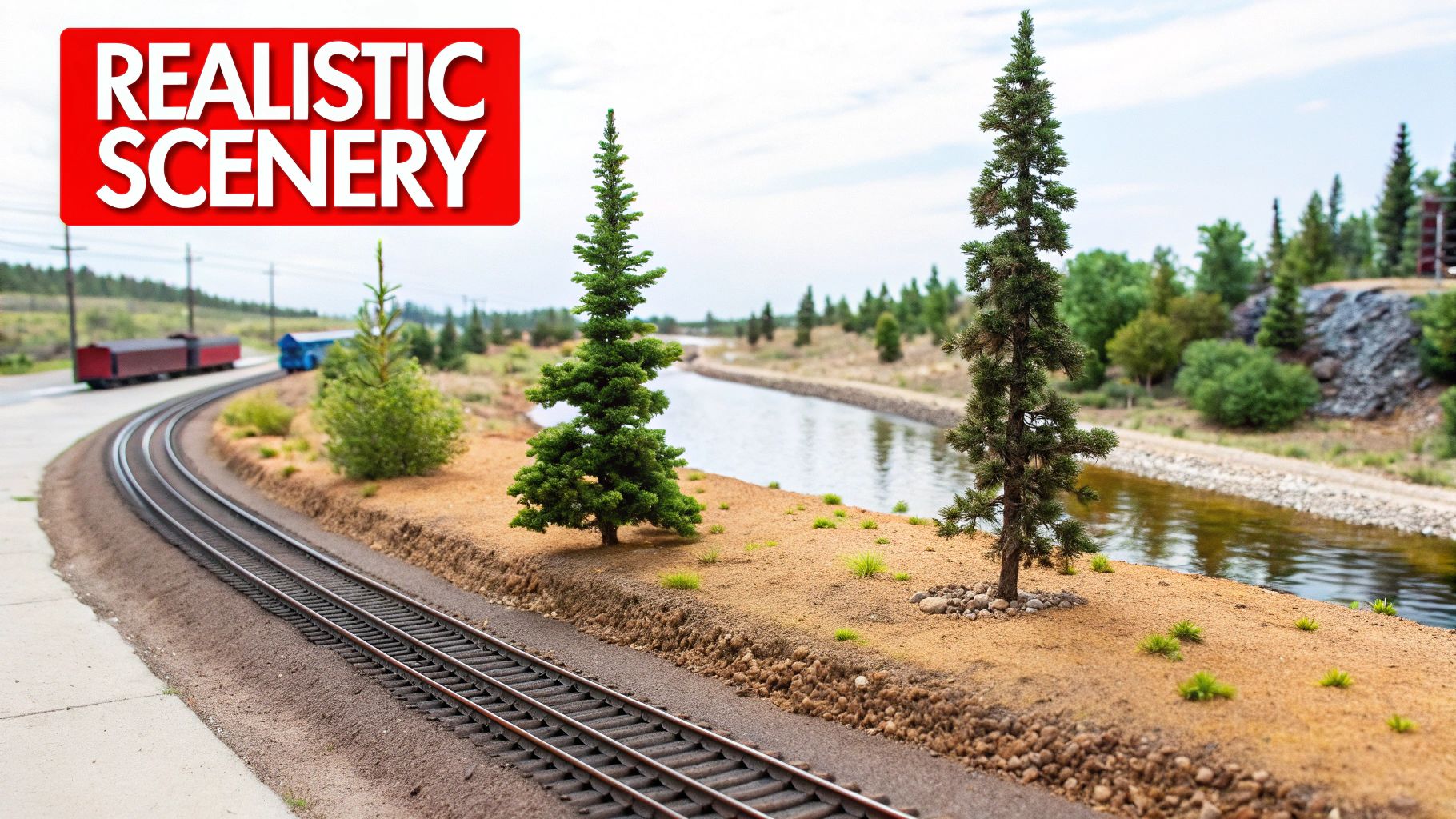
This is where the real magic happens. It’s the part of the journey where a flat tabletop of track transforms into a believable, breathing world. Creating scenery for your N scale trains is easily the most artistic and rewarding part of the hobby, turning your railroad into a true piece of art. The secret isn't complicated: think in layers and always choose finer materials that look right in this smaller scale.
Your first step is shaping the basic landforms. Forget about the old days of heavy, messy plaster. Most modern layouts start with a base of extruded foam insulation board, which you can find at any home improvement store. This stuff is a game-changer—it’s incredibly lightweight, a breeze to cut with a craft knife or hot wire foam cutter, and you can stack and glue it to build up hills, valleys, and even dramatic mountain ranges. From there, you just carve and sand it into flowing, natural contours.
Once your terrain is shaped, it's time for color and texture. A simple base coat of flat tan or brown latex paint does two things: it seals the foam and gets rid of that artificial pink or blue color, giving you a nice, earthy foundation for everything that comes next.
Building Up Realistic Ground Cover
With your earth-colored base down, the next layer is ground cover. This is where your world really starts to feel real. Because N scale is so small, the texture of your scenic materials is absolutely critical. Coarse stuff that looks just fine in HO or O scale will immediately look cartoonish and out of place here.
The key is to use very fine scenic materials. You'll want to spread a thin, even coat of diluted white glue (a 50/50 mix with water is perfect) and then start building up your textures.
- Fine Turf: Begin with a base layer of finely ground foam turf. Use a few different shades of green and brown to represent patches of grass and soil.
- Static Grass: For incredibly realistic fields and grassy patches, a static grass applicator is an amazing tool. It uses a static charge to make tiny fibers stand up straight, just like real blades of grass.
- Small Bushes and Shrubs: Use clumps of slightly coarser ground foam or specialty foliage materials to create undergrowth, weeds, and small bushes.
- Dirt and Gravel Roads: You can't beat the real thing. Very fine sand or even sifted dirt from your own backyard (just bake it in an oven first to sterilize it) makes for perfect dirt roads and gravel lots.
The goal is to build up textures gradually. You want to blend different colors and materials together to avoid a uniform, golf-course look. Nature is messy and varied—your N scale scenery should be, too.
Ballasting Track and Adding Details
One of the single most impactful scenic jobs is applying ballast—that's the crushed rock you see supporting the railroad ties. In N scale, this one step will elevate your track from looking like a toy to looking like a miniature railroad. Make sure you use extra-fine ballast made specifically for N scale.
The process takes patience, but it's straightforward:
- Carefully spoon the fine ballast between the rails and along the shoulders of the track.
- Use a soft paintbrush to gently sweep any loose ballast off the tops of the ties.
- Lock it all in place by slowly dripping a mix of diluted white glue (with a tiny drop of dish soap to break the surface tension) onto the ballast.
Beyond the ground cover, it’s the little details that really tell a story. Adding buildings, vehicles from the correct era, road signs, and tiny figures breathes life and atmosphere into your scenes. A few figures waiting at a station or a truck parked at a loading dock instantly creates a sense of purpose and activity. These small elements are what draw a viewer in, making your miniature world feel truly inhabited.
Your Essential N Scale Starter Checklist
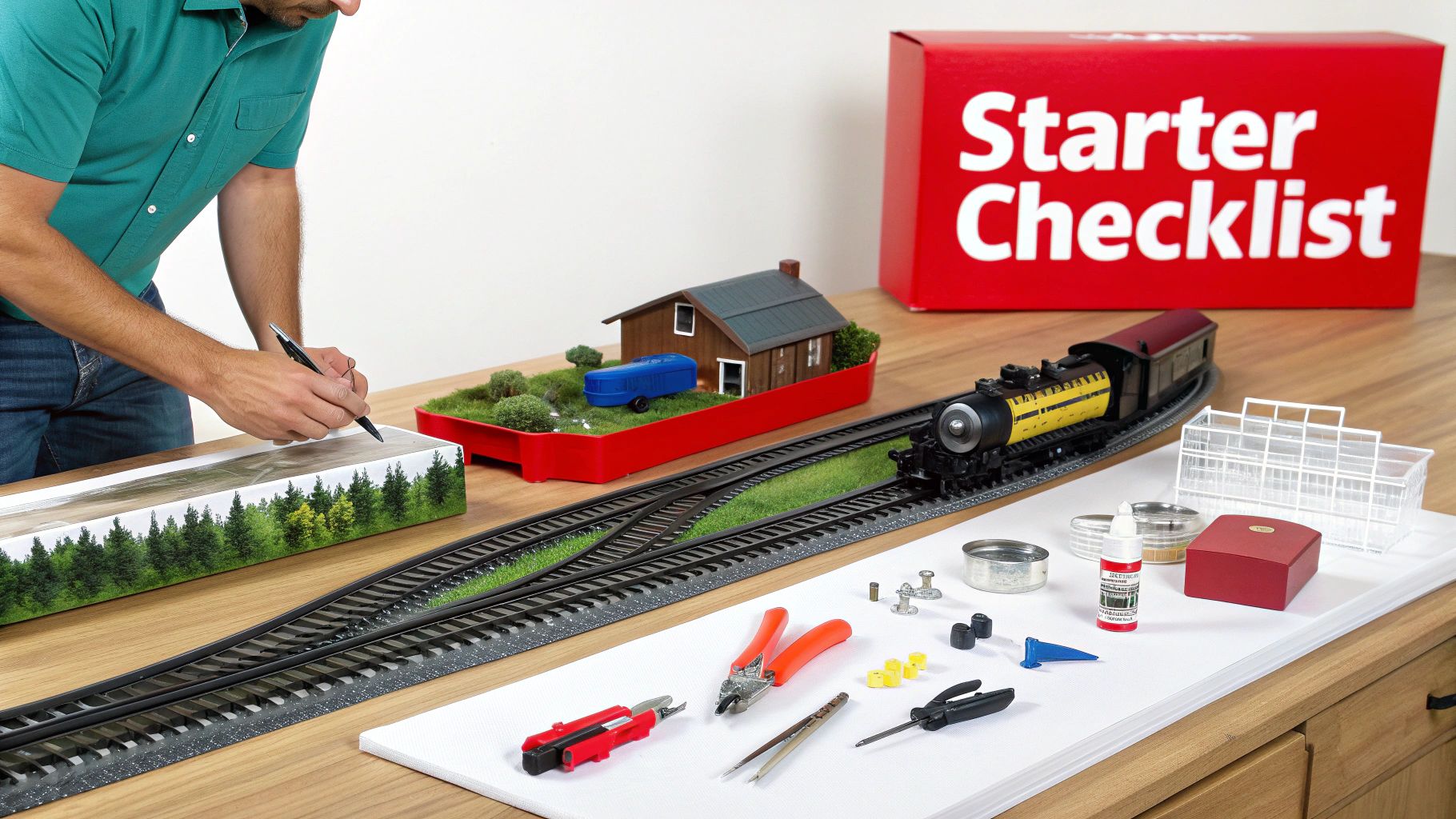
So, you're ready to jump into the world of N scale trains? That's fantastic. This is your no-nonsense guide to making that first purchase and getting started on the right foot. Think of it as a shopping list to kickstart your model railroading journey, making sure you get quality gear that will be the foundation of your hobby for years.
For almost everyone starting out, the absolute best way to begin is with an all-in-one starter train set. This isn’t just the easy route; it's the smartest. These kits pack everything you need to get a train running in minutes: a locomotive, a few cars, an oval of track, and a power pack.
The huge win with a starter set is guaranteed compatibility. Everything is designed to work together right out of the box. You won't have to worry if your engine works with the controller or if the couplers match up. It completely removes the guesswork and lets you get straight to the fun part—running your first train.
Your First Core Purchase
When you're picking a set, stick with trusted brands like Kato or Bachmann. They're known for making reliable locomotives and quality track, which is a big deal in N scale where precision is everything.
A good set gives you a solid base that you can easily build upon. That first oval of track can become the start of a much bigger layout, and the engine and cars will be the first members of your growing roster. To get a feel for what makes a great engine, check out our guide on the best N scale locomotives.
Don't just think of a starter set as a toy. It's the first real investment in your hobby. It provides the essential DNA—track, power, and rolling stock—that your entire railroad empire will grow from.
Essential Tools and Supplies
Beyond the train set itself, a few basic tools will make your life a whole lot easier. You don’t need a huge workshop right away, just a handful of essentials to handle common tasks.
Getting started can feel like a lot, so we put together this simple shopping list to make it easy. These are the absolute must-haves for building your first layout.
Beginner N Scale Shopping Checklist
| Item Category | Essential Items | Optional First Upgrades |
|---|---|---|
| Train Set | All-in-one starter set (locomotive, cars, track, power pack) | Extra track pack (turnouts, straight/curved sections) |
| Basic Tools | Rail Nippers, Needle-Nose Pliers, Hobby Knife | Screwdriver set (for maintenance/DCC installs) |
| Track Maintenance | Track Cleaning Block, Isopropyl Alcohol (91%+) | Track cleaning car |
| Work Surface | Clean, flat table or a 2'x4' piece of plywood/foam board | A dedicated modeling mat with grid lines |
This checklist covers the core components that will take you from unboxing to running trains smoothly. Starting with these items ensures you have a reliable foundation and can focus on enjoying the hobby from day one.
Common N Scale Questions Answered
As you dive deeper into N scale, you'll naturally start bumping into some of the practical, "what if" questions. It's a normal part of the process! Here are a few of the most common ones we hear from folks just getting started.
Are Different N Scale Brands Compatible?
Yes, for the most part, they play very nicely together. The most important thing is that all N scale equipment is built to run on the same 9mm gauge track. This means a locomotive from Kato will run perfectly fine on a piece of Atlas track.
The one snag you might hit is with couplers, especially when mixing older models with brand-new ones. Thankfully, most modern manufacturers have settled on a standard knuckle coupler design. If you have some older rolling stock with a different style, swapping them out for new couplers is a simple upgrade and a rite of passage for many modelers.
How Do I Keep My N Scale Track and Wheels Clean?
Because everything is smaller in N scale, a little bit of dust and grime can cause big problems with electrical pickup, leading to stuttering or stalled locomotives. The key is consistent, gentle cleaning.
Regularly wipe down your track with a dedicated track-cleaning block or a lint-free cloth lightly dampened with isopropyl alcohol. For your locomotive's wheels, you can carefully touch a spinning, powered wheel with an alcohol-dampened cotton swab. You can also find specialized wheel-cleaning tools that make the job even easier. A few minutes of cleaning here and there will keep your trains running smoothly for hours.
At Fusion Scale Hobbies, we carry everything you need to start and maintain your N scale railroad, from starter sets to track cleaning supplies. Explore our massive selection of N scale trains and accessories at fusionscalehobbies.com.